

Business Guides, Business Strategy, e-invoicing, e-Invoicing Solution
How E-Invoicing Changes UAE Property Finance: Off-Plan, Progressive Billing, Service Charges
14 SEPTEMBER 2026 • 5 Min read

How E-Invoicing Changes UAE Property Finance
Off-plan, Progressive billing, Service charges, & Designated zones. The four UAE real-estate flows where e-invoicing reshapes finance operations.
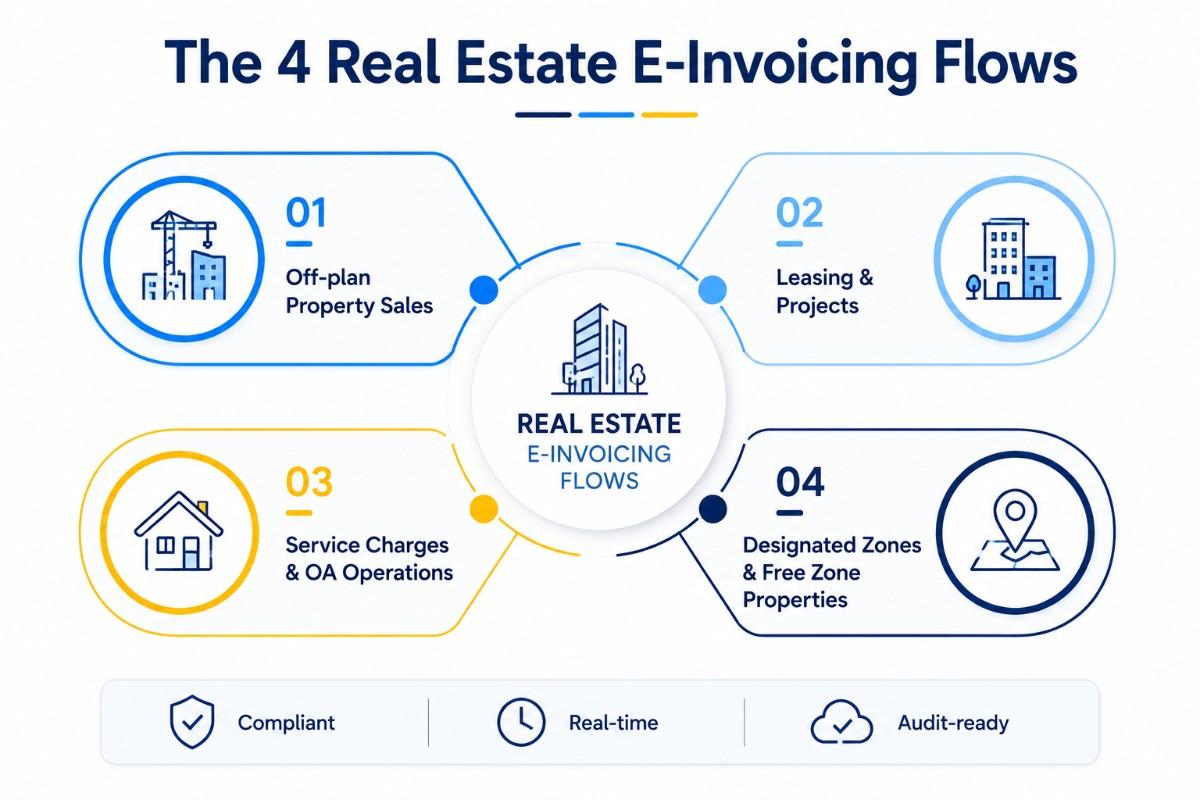
Real estate is the industry where UAE e-invoicing meets the longest payment cycles, the most fragmented entity structures, and the most ambiguous customer-vs-buyer boundaries. A property finance team manages cash flows that span 36 months for off-plan, 12 months for service charges, and decades for lease portfolios.
Each of those flows has its own invoice rhythm, its own VAT treatment, and its own e-invoicing implications. There is no single “real estate e-invoicing solution”; there are four sub-flows that need to be solved together, but each separately.
Below: each of the four. What changes, what doesn’t, and where the friction is.
Flow 1: Off-plan property sales
Off-plan is the dominant new-property model in the UAE. A buyer pays a series of installments over 18–36 months as the development progresses. Each installment, under UAE VAT, generates a tax invoice; and under e-invoicing, that tax invoice must be structured, transmitted, and reported.
What’s new under e-invoicing:
- Every installment invoice is in scope. Not just the completion invoice. Each draw triggers a structured invoice obligation.
- Invoice timing must match construction milestones. If your developer’s milestone schedule slips by 6 weeks, your invoicing rhythm slips too, and the structured data must reflect reality, not the original sales agreement schedule.
- Cancellations and re-sales (when a buyer sells the unit before completion) create credit-note chains that span the original buyer and the new buyer. PINT AE handles this, but only if your back-office process maps it correctly.
- Penalties for late payment, payment plan rescheduling, and currency of payment variations all interact with the structured invoice format. Your accounting system must be produced correctly.
Flow 2: Progressive billing (commercial leasing, build-to-suit)
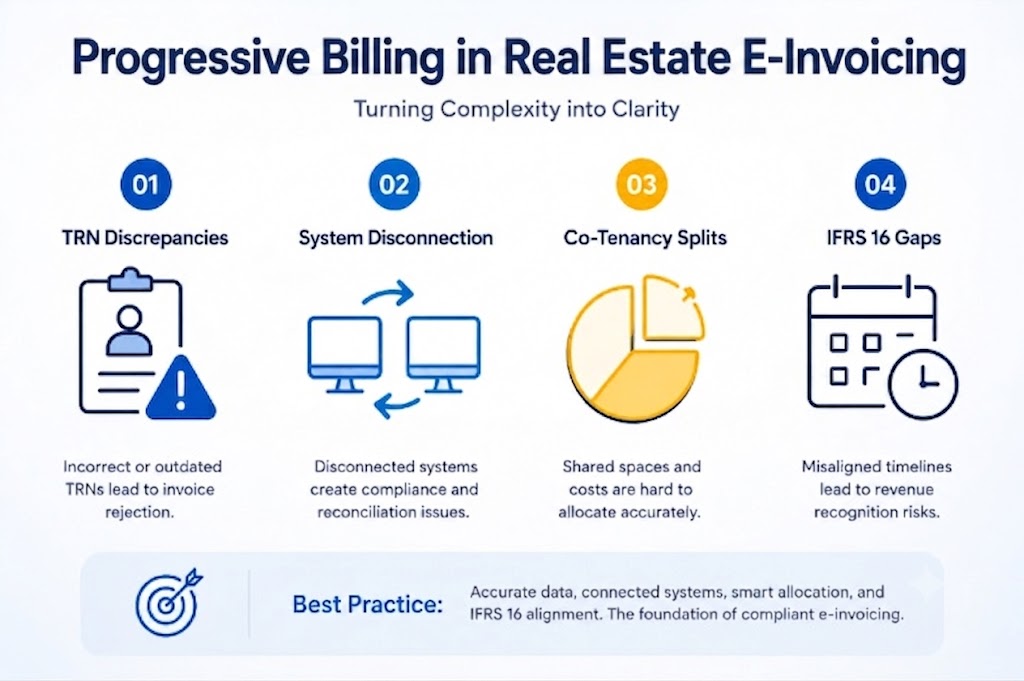
Standard commercial leases for offices, retail bays, and warehouses typically invoice on fixed annual, semi-annual, or quarterly schedules. Conversely, build-to-suit and major fit-out projects utilize progressive invoicing tied directly to verifiable construction milestones. Both are in scope.
- TRN Discrepancies: Changes in TRNs by Tenants, if not updated in the masters, cause automated e-invoice validation to fail instantly.
- System Disconnection: Separating rent ERP from service charge software requires heavy compliance and tax reconciliation.
- Co-Tenancy Splits: Standard PINT-AE templates cannot split shared space invoices without custom system configuration.
- IFRS 16 Gaps: E-invoicing mandates strict transactional timelines that force operational alignment with IFRS 16 revenue recognition schedules.
Flow 3: Service charges and OA (Owners Association) operations
Service charges in UAE for residential and mixed-use developments are typically invoiced annually or quarterly to unit owners by the OA or its appointed property manager. Volumes are high (every unit owner in a tower), values are individually small, and the invoicing infrastructure is often a property-management platform, not a finance ERP.
What changes:
- Property-management platforms become e-invoicing-scoped. If your OA software produces tax invoices, it must produce structured ones or hand off cleanly to a system that does.
- Unit owners are often individuals, sometimes companies, and sometimes overseas entities. The “buyer identity” data quality varies hugely. TRN capture (where applicable) is sparse and inconsistent.
- Bulk processing issuing 800 service charge invoices on the same day for a single tower is a volume profile that some property management platforms have not been engineered for. Validation failures at scale become operationally serious.
- Disputes are common (owners disputing charges, partial payments, late penalties). Each dispute triggers a credit note or adjustment flow. The structured invoice version of this must be operationally clean.
Flow 4: Designated zones and free zones
Many UAE property developers operate entities in designated zones and in non-designated free zones. The VAT treatment of property supplies into and out of designated zones differs in specific cases.
E-invoicing specifically:
- Designated Zone Exemptions: Supplies within Designated Zones may fall outside the scope of UAE VAT, requiring specific tax codes and structural adjustments on the electronic invoice.
- Intragroup Transactions: Billing between mainland and Designated Zone entities within the same corporate group demands precise characterization of VAT treatment at the transaction level.
- Zone Differentiation: Systems must distinguish between Free Zones and Designated Zones at the invoice line level to comply with PINT-AE data requirements.
- Tax Validation: Entities must confirm their classifications in writing with a tax advisor and validate that the Accredited Service Provider (ASP) configuration reflects these rules before go-live.
H2: A property-specific 90-day readiness plan
- Weeks 1-2: Inventory all four flows above. Confirm which entities in your group are touched by which flow.
- Week 3: System landscape: property management platforms, lease management software, finance ERP. Map who owns invoice generation for what.
- Week 4: Designated-zone classification audit per entity, signed off by tax advisor.
- Weeks 5-6: Master data audit: tenant TRNs, unit owner identities, off-plan buyer details.
- Weeks 7-8: ASP shortlist, with real estate-specific demos (progressive billing, OA bulk processing, designated zone routing).
- Weeks 9-10: Integration design for each flow.
- Weeks 11-12: Sandbox testing per flow.
Four Property Flows, One Compliance Deadline
Off-plan draws, progressive billing schedules, service charge runs, and designated zone transfers rarely sit inside a single system, yet every one of them now has to produce a structured invoice that the FTA will accept.
A missed milestone update or an unclassified zone entity is enough to stall an entire tower’s worth of service charge billing. KPI’s e-invoicing advisory specialists work with UAE developers, landlords, and owners associations to map each of these flows individually and get the invoicing rhythm aligned before the compliance deadline arrives.
Where VAT treatment on designated zones or intragroup billing needs sign-off, our VAT advisory services and corporate tax services teams work alongside the e-invoicing specialists, backed by our wider tax advisory services for anything spanning multiple entities.
Bring your property portfolio to KPI’s advisors and get in touch here to start mapping your 90-day readiness plan.



Stay Ahead of the Curve
Subscribe for Expert Audit and Financial Insights Directly to Your Inbox.