

Business Guides, Company Formation in UAE
Documents Required to Start a Business in Dubai: Complete Guide
18 SEPTEMBER 2026 • 13 Min read

Missing or incorrect paperwork is one of the most common reasons a Dubai company registration gets delayed. Authorities need to verify who the shareholders are, what activity the business will actually carry out, and where the company will operate from, before a trade licence is issued. Get the documentation right the first time, and most applications move through the system in a matter of days. Get it wrong, and you can lose weeks chasing attestations, re-submitted forms, or missing approvals.
This guide walks through exactly what’s needed for business setup documents Dubai requires, broken down by jurisdiction, shareholder type, and business activity, because the honest answer is that no single checklist applies to every company. Requirements shift depending on whether you’re setting up on the mainland, in a free zone, or offshore, and they can change based on your nationality, your activity, and whether your shareholder is an individual or another company. Always verify current requirements with the relevant authority or the UAE Government business portal before submitting anything, since rules do get updated.
What Documents Do You Need to Start a Business in Dubai?
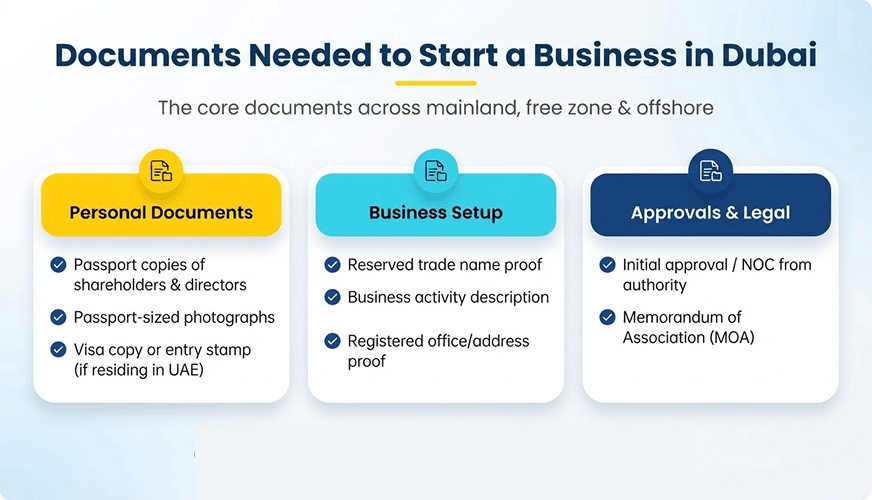
Regardless of which jurisdiction you choose, a core set of documents comes up again and again across mainland, free zone, and offshore applications:
- Passport copies of all shareholders and directors
- Passport-sized photographs
- Proof of the reserved trade name
- A clear description of the intended business activity
- Proof of registered office or address, where applicable
- Initial approval or no-objection certificate from the relevant authority
- Memorandum of Association (MOA), where the legal structure requires one
- Visa copy or entry stamp for shareholders already residing in the UAE, where relevant
Company formation requirements UAE-wide tend to follow this same skeleton, but the specific documents that get layered on top depend heavily on jurisdiction, so let’s break each one down separately.
Documents Required for Dubai Mainland Company Formation
Mainland companies are licensed by Dubai’s Department of Economy and Tourism (DET, formerly known as DED), and this jurisdiction generally carries the most extensive documentation requirements since the company can trade across the entire UAE and take on government contracts.
Typical mainland company setup documents include:
- Passport copies of all shareholders and managers
- Trade name reservation certificate
- Initial approval certificate from DET
- A duly attested Memorandum of Association
- A registered tenancy contract recorded through Ejari, since a commercial office address is required for almost all mainland licences
- Local Service Agent agreement, attested where the activity or ownership structure requires one
- Approvals from other government entities where the activity calls for them, such as healthcare, education, or legal services
Because mainland companies interact with several government bodies, from DET to the Ministry of Human Resources and Emiratisation for labour registration, keeping a master file of every submitted document saves considerable back-and-forth later. KPI’s mainland company formation team manages this coordination directly with DET, notaries, and landlords so nothing gets missed.
Documents Required for a Dubai Free Zone Company
Free zone documentation is often lighter than mainland, particularly for smaller businesses using flexi-desk or shared office packages, but it still varies significantly from one free zone authority to another.
Common documents include:
- Passport copies of shareholders and directors
- Passport-sized photographs
- A completed application form specific to the chosen free zone
- Business plan, required by some free zones depending on the activity
- Proof of address for shareholders, such as a recent utility bill or bank statement
- Office or flexi-desk agreement issued by the free zone authority, which serves as address proof
- Board resolution, where the shareholder is a corporate entity
Since free zones are often built around specific sectors, some also request activity-specific documents, like educational certificates for consultancy licences or portfolio samples for creative and media licences. If you’re comparing options, KPI supports setup across several established free zones, including JAFZA, DMCC, DWTC, RAKEZ, and Sharjah Airport International Free Zone, each with its own document checklist worth reviewing before you commit to one.
Documents Required for Offshore Business Setup in Dubai
Offshore business setup in Dubai works differently from mainland or free zone structures. An offshore company, typically registered through JAFZA Offshore, RAK ICC, or Ajman Offshore, is a non-resident entity built for holding assets, international trading, or intellectual property ownership. It cannot lease office space, trade inside the UAE local market, or sponsor residence visas, and it must be registered through a licensed registered agent rather than applying directly to the authority.
Documents typically required include:
- Passport copies of shareholders, directors, and beneficial owners
- Proof of residential address, such as a utility bill or bank statement
- A brief CV or professional background summary for each shareholder
- A short business plan outlining the intended activity
- Board resolution and certificate of incorporation, if the shareholder is a corporate entity
One point worth flagging clearly: documents issued outside the UAE, particularly corporate documents from foreign shareholders, often need notarisation and either embassy attestation or an apostille stamp before submission. This step alone can take longer than the actual registration if it isn’t started early.
Documents Needed for a UAE Business If the Shareholder Is a Foreigner
Foreign ownership is now available for the large majority of business activities across mainland, free zone, and offshore structures in the UAE. That said, foreign individual shareholders generally need to provide:
- A clear colour copy of a valid passport, with at least six months’ validity remaining
- Passport-sized photographs against a white background
- Proof of current residential address in their home country
- UAE visa copy or entry stamp, if already inside the country
If documents were issued in a country that isn’t part of the Hague Apostille Convention, they typically need attestation through the UAE embassy in that country, followed by attestation from the UAE Ministry of Foreign Affairs once inside the UAE. This is one of the most frequently underestimated steps in the entire process, so it deserves early attention rather than being left until the final submission stage.
Documents Required When a Company Is a Shareholder
When a corporate entity holds shares instead of an individual, the document list expands. Authorities need to verify that the parent company exists, is authorised to invest, and has properly delegated someone to act on its behalf. Expect to provide:
- Certificate of incorporation of the parent company
- Memorandum and Articles of Association of the parent company
- A board resolution authorising the UAE investment and naming an authorised signatory
- Certificate of good standing or equivalent, confirming the company is active
- Passport copy of the authorised signatory representing the parent company
As noted earlier, foreign corporate documents almost always require notarisation and legalisation before UAE authorities will accept them, and this process can take several weeks depending on the home jurisdiction, so it’s worth starting well ahead of your target registration date.
Documents Required for Getting a Dubai Trade Licence
Once the formation documents are approved, a separate set of requirements applies specifically to issuing the trade licence itself. This is where the trade licence documentation Dubai authorities ask for typically includes:
- Initial approval certificate
- Trade name certificate
- Final Memorandum of Association, where required
- Ejari tenancy contract or free zone office agreement
- Passport copies of all shareholders
- Activity-specific external approvals, where the licensed activity calls for them
- Payment receipts for licence fees
This stage is essentially a checkpoint where the authority confirms everything submitted earlier is consistent, complete, and correctly attested before the licence is finally printed.
Additional Documents for Regulated Business Activities
Certain activities cannot proceed on standard documentation alone because a separate regulator needs to sign off first. This applies to sectors such as healthcare, education, legal consultancy, financial services, engineering, and food-related businesses. Depending on the activity, this can mean:
- Professional qualification certificates, attested and sometimes translated.
- Experience letters from previous employers
- Approval from the relevant federal or local ministry or regulator
- Facility inspection or fit-out approval, for physical premises like clinics or food outlets
These approvals often take the longest of any step in the process, so identifying whether your activity is regulated should happen at the very start, not after you’ve already reserved a trade name.
Post Incorporation Things to do
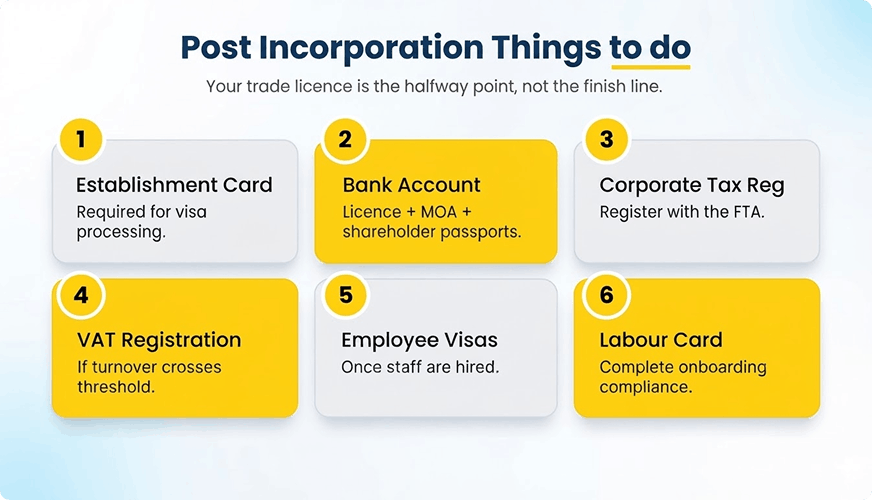
Getting the licence issued isn’t the finish line. A handful of post-formation documents are needed to actually start operating:
- Establishment card, required for visa processing through immigration and labour authorities
- Corporate bank account opening documents, including the trade licence, MOA, and shareholder passports
- Corporate Tax registration, since most UAE businesses are required or eligible to register with the FTA
- VAT registration, if turnover crosses the mandatory threshold
- Employee visa and labour card documentation, once staff are hired
This is where a lot of new business owners lose momentum, simply because they treat the trade licence as the end of the process rather than the halfway point. KPI’s Corporate Tax services and VAT advisory services teams help new companies handle this stage properly, so registration and compliance don’t become an afterthought.
How to Organize Your Documents Before Applying
A little structure at the start saves a lot of frustration later. It helps to separate documents into four clear categories rather than keeping everything in one folder:
- Licensing documents: trade name certificate, initial approval, MOA, tenancy or office agreement
- Visa documents: passport copies, entry stamps, establishment card, NOC letters
- Banking documents: trade licence, shareholder passports, MOA, proof of address
- Tax documents: Corporate Tax registration certificate, VAT registration (if applicable), financial records
Keeping digital copies alongside originals, checking expiry dates on passports and attestations before submission, and confirming translation requirements upfront are small habits that consistently shorten setup timelines.
Common Documentation Mistakes Entrepreneurs Should Avoid
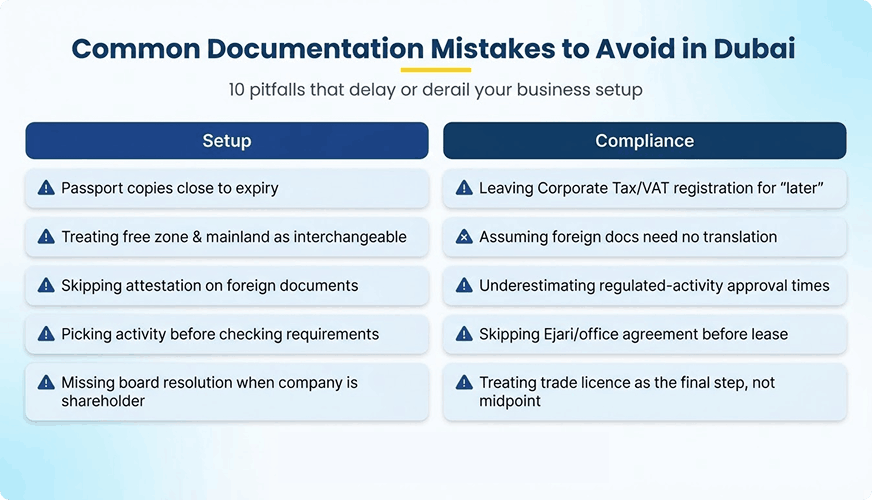
- Submitting passport copies that are close to expiry
- Assuming free zone and mainland requirements are interchangeable
- Skipping attestation on foreign corporate documents until the application is rejected
- Choosing a business activity before checking what documents that activity requires
- Not preparing a board resolution in advance when a company is a shareholder.
- Leaving Corporate Tax and VAT registration for “later”
- Assuming one country’s document format will be accepted without translation
- Underestimating how long regulated-activity approvals take
- Not confirming Ejari or office agreement requirements before signing a lease.
- Treating the trade licence as the final step rather than the midpoint
How to Start a Business in Dubai: Document-First Process
If you’re trying to work out how to start a business in Dubai with documentation front of mind, this sequence keeps things structured from day one.
Step 1: Choose your business activity. This decision shapes almost every document you’ll need afterward.
Step 2: Select the jurisdiction. Mainland, free zone, or an appropriate offshore structure, based on your customers and operating model.
Step 3: Select the legal structure. This determines whether an MOA, board resolution, or other founding documents are required.
Step 4: Check the exact document requirements for your chosen activity and jurisdiction, rather than relying on a generic checklist.
Step 5: Reserve the trade name.
Step 6: Obtain initial approval where applicable.
Step 7: Submit formation documents, including attested corporate paperwork if a company is a shareholder.
Step 8: Arrange premises where required, and register the tenancy through Ejari for mainland companies.
Step 9: Obtain additional approvals for regulated activities.
Step 10: Obtain the business licence.
Step 11: Complete post-formation requirements, including banking, Corporate Tax registration, and visa processing.
Following this order, rather than jumping straight to submitting an application, is what keeps most Dubai company registrations moving smoothly from start to finish.
Conclusion
Documentation is the part of Dubai business setup that decides how smoothly everything else goes. The requirements genuinely differ by jurisdiction, shareholder type, and business activity, so treating any single checklist as universal is where most delays start. Getting organised early, understanding which category each document falls into, and confirming current requirements before you submit anything will save you real time.
Let KPI Handle the Paperwork While You Focus on the Business
Chasing attestations, tracking down approvals, and figuring out which document goes to which authority isn’t how founders should be spending their setup phase. KPI’s Dubai business setup services team manages the full documentation process for mainland, free zone, and offshore structures, so your application moves through DET or the relevant free zone authority without unnecessary back-and-forth.
Beyond company formation, KPI also supports growing businesses with:
- Mainland company formation and free zone business setup across the UAE
Reach out to KPI today, and let our team put together your document checklist before you submit a single form.
FAQs
1. What documents are required to start a business in Dubai?
Core requirements generally include shareholder passport copies, trade name reservation, proof of business activity, an office or address agreement, and initial approval from the relevant authority. Exact requirements vary by jurisdiction and activity.
2. What documents are required for a Dubai mainland company?
Mainland companies typically need shareholder passport copies, a trade name certificate, initial approval from DET, an attested Memorandum of Association, and an Ejari-registered tenancy contract, along with any activity-specific approvals.
3. Do I need a UAE residence visa to start a business in Dubai?
Not necessarily to form the company itself, but you will need a visa or entry status to live and work in the UAE afterward. Requirements depend on the structure you choose and whether you plan to sponsor your own residence visa through the company.
4. What documents are required for a Dubai free zone company?
Typical requirements include shareholder passport copies, a completed free zone application form, proof of address, and an office or flexi-desk agreement issued by the free zone authority. Some free zones also request a business plan or activity-specific documents.
5. What documents are required for offshore business setup in Dubai?
Offshore structures, such as JAFZA Offshore or RAK ICC, generally require shareholder passport copies, proof of address, a bank reference letter, a brief CV, and a short business plan, submitted through a licensed registered agent.
6. Do documents need to be attested to start a business in Dubai?
Often, yes, particularly for documents issued outside the UAE or where a company (rather than an individual) is a shareholder. Foreign corporate documents typically need notarisation and either embassy attestation or an apostille before UAE authorities will accept them.
{ “@context”: “https://schema.org”, “@type”: “FAQPage”, “mainEntity”: [{ “@type”: “Question”, “name”: “What documents are required to start a business in Dubai?”, “acceptedAnswer”: { “@type”: “Answer”, “text”: “Core requirements generally include shareholder passport copies, trade name reservation, proof of business activity, an office or address agreement, and initial approval from the relevant authority. Exact requirements vary by jurisdiction and activity.” } },{ “@type”: “Question”, “name”: “What documents are required for a Dubai mainland company?”, “acceptedAnswer”: { “@type”: “Answer”, “text”: “Mainland companies typically need shareholder passport copies, a trade name certificate, initial approval from DET, an attested Memorandum of Association, and an Ejari-registered tenancy contract, along with any activity-specific approvals.” } },{ “@type”: “Question”, “name”: “Do I need a UAE residence visa to start a business in Dubai?”, “acceptedAnswer”: { “@type”: “Answer”, “text”: “Not necessarily to form the company itself, but you will need a visa or entry status to live and work in the UAE afterward. Requirements depend on the structure you choose and whether you plan to sponsor your own residence visa through the company.” } },{ “@type”: “Question”, “name”: “What documents are required for a Dubai free zone company?”, “acceptedAnswer”: { “@type”: “Answer”, “text”: “Typical requirements include shareholder passport copies, a completed free zone application form, proof of address, and an office or flexi-desk agreement issued by the free zone authority. Some free zones also request a business plan or activity-specific documents.” } },{ “@type”: “Question”, “name”: “What documents are required for offshore business setup in Dubai?”, “acceptedAnswer”: { “@type”: “Answer”, “text”: “Offshore structures, such as JAFZA Offshore or RAK ICC, generally require shareholder passport copies, proof of address, a bank reference letter, a brief CV, and a short business plan, submitted through a licensed registered agent.” } },{ “@type”: “Question”, “name”: “Do documents need to be attested to start a business in Dubai?”, “acceptedAnswer”: { “@type”: “Answer”, “text”: “Often, yes, particularly for documents issued outside the UAE or where a company (rather than an individual) is a shareholder. Foreign corporate documents typically need notarisation and either embassy attestation or an apostille before UAE authorities will accept them.” } }] }


Stay Ahead of the Curve
Subscribe for Expert Audit and Financial Insights Directly to Your Inbox.