

Audit & Assurance
Audit and Assurance Services in UAE for Transparent Financial Reporting
02 NOVEMBER 2026 • 19 Min read

Audit and assurance services in the UAE give shareholders, investors, lenders, regulators, and other stakeholders an independent basis for relying on a company’s financial statements. An audit provides reasonable assurance on whether the financial statements are free from material misstatement, whether due to fraud or error, and whether they are prepared and presented, in all material respects, in accordance with the applicable financial reporting framework, such as IFRS. An audit is the most formal type of assurance engagement, built around an independent examination of the financial statements. Assurance more broadly covers a range of engagements in which an independent practitioner gives a conclusion on specific financial or operational information.
Together, these services support the transparent financial reporting that UAE companies need to raise capital, secure financing, meet regulatory requirements, and build the confidence of everyone with a stake in the business. This guide covers what audit and assurance include, why they matter, how the process works, and how a UAE business should approach choosing the right provider.
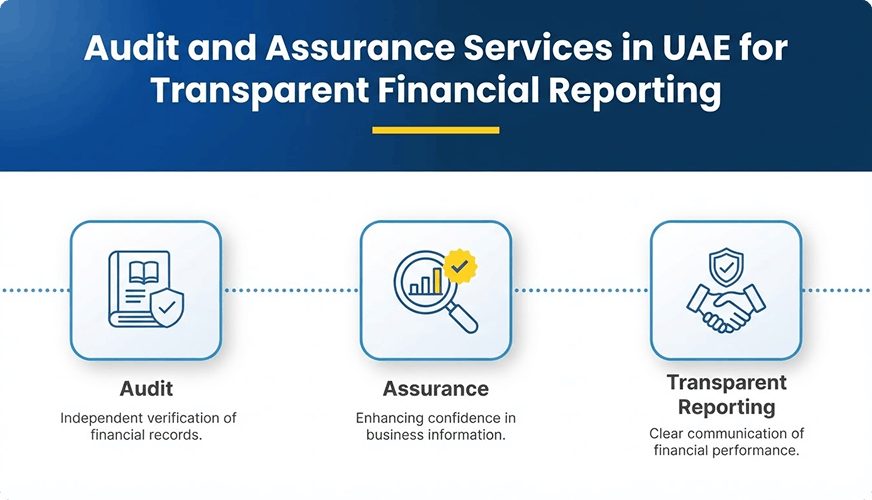
Quick answer: UAE businesses typically use audit and assurance services in two related forms. An audit is an independent examination of a company’s complete set of financial statements that ends in a signed opinion, and it is most commonly needed for statutory filings, licence renewals, and corporate tax purposes. Assurance is the broader category, which also includes review engagements and other assurance engagements that give a conclusion on specific information without the full scope of an audit. Agreed-upon procedures are a separate related service: the practitioner reports factual findings from procedures agreed with the client but gives no assurance. KPI’s audit services UAE team helps businesses work out which engagement fits their obligations before committing to one.
What Are Audit and Assurance Services in the UAE?
Audit and assurance services are independent examinations of a company’s financial information, carried out by a licensed professional to confirm that the information can be relied upon by the people reading it. Auditors registered with the Ministry of Economy and Tourism’s Auditors Department, which licenses and oversees auditors and auditing firms for compliance with applicable legislation and professional performance standards, are the professionals authorized to carry out these engagements in the UAE. The two terms are related but not identical, and understanding the difference helps a business ask for the right service in the first place.
What Is an Audit?
An audit is a specific, formal type of assurance engagement. It involves an independent auditor examining a company’s financial statements against a defined reporting framework, typically International Financial Reporting Standards (IFRS) or IFRS for SMEs, and forming an opinion on whether those statements present a true and fair view of the company’s financial position. An audit results in a signed auditor’s report, and it is the engagement most commonly required for statutory purposes, license renewals, and corporate tax compliance.
What Are Assurance Services?
Assurance services are the broader category that audits sit within. Beyond a full financial statement audit, assurance can include reviews that offer a more limited level of assurance than a full audit, agreed-upon procedures engagements focused on a specific area rather than the whole financial statements, internal control assessments, due diligence work supporting a transaction, and other engagements that verify particular information for a specific purpose. Every audit is an assurance engagement, but not every assurance engagement is a full audit, and the right choice depends on what level of confidence a business, its bank, or its investors actually need.
Why Are Audit and Assurance Services Important for UAE Businesses?
Audit and assurance services solve several distinct problems for a business at once, and each one shows up differently depending on who is asking for the engagement and why.
Improve Financial Reporting Accuracy
An external, independent review catches errors, misclassifications, and inconsistent accounting treatments that internal teams, however capable, often miss simply because they are close to the numbers every day. Financial reporting accuracy compounds over time; a small classification error left uncorrected in one year tends to repeat itself in the next.
Strengthen Internal Controls
As part of planning and performing the audit, auditors obtain an understanding of the internal controls relevant to financial reporting. A financial statement audit is not designed to express an opinion on how effective those controls are, unless the auditor is separately engaged to report on them. Even so, the auditor communicates control deficiencies identified during the audit to management and those charged with governance. Examples include a gap in approval authority or a reconciliation that is not performed consistently. These findings help management see where controls need attention before the issues grow into bigger problems.
Support Regulatory Compliance
Many UAE businesses face overlapping compliance obligations tied to the Commercial Companies Law, free zone licensing conditions, and corporate tax requirements, and an audit produces the documented financial statements that satisfy several of these obligations at once. Businesses managing VAT advisory and corporate tax services alongside their audit tend to find the three functions reinforce each other, since consistent, audited figures make every other compliance filing more straightforward.
Improve Decision-Making
Owners and management teams make better decisions when they trust the numbers in front of them. An audited set of financial statements gives leadership a verified baseline for budgeting, expansion decisions, and performance reviews, rather than working from figures that have never been independently checked.
Increase Stakeholder Confidence
Every external party a business deals with, from a bank assessing a loan application to an investor evaluating a stake, relies on financial statements they had no role in preparing. An independent audit is what allows those parties to place weight on the numbers without having to verify them personally.
How Do Audit Services Improve Transparent Financial Reporting in UAE?
Transparency in financial reporting comes down to whether the numbers a business publishes match what actually happened in the business, presented consistently and completely enough that a reader can trust them without independently re-checking every line. Audit services improve this in a few concrete ways: they apply a consistent accounting framework across periods so figures are comparable year to year, they test transactions and balances against underlying evidence rather than accepting management’s figures at face value, they require disclosure of related-party transactions and significant judgments that might otherwise stay hidden inside the numbers, and they produce a signed, independent opinion that gives a reader a clear signal about how much confidence to place in the statements. This is what separates a set of internally prepared accounts, however carefully done, from an audited set that a bank, investor, or regulator can rely on directly.
What Is a Financial Statement Audit in UAE?
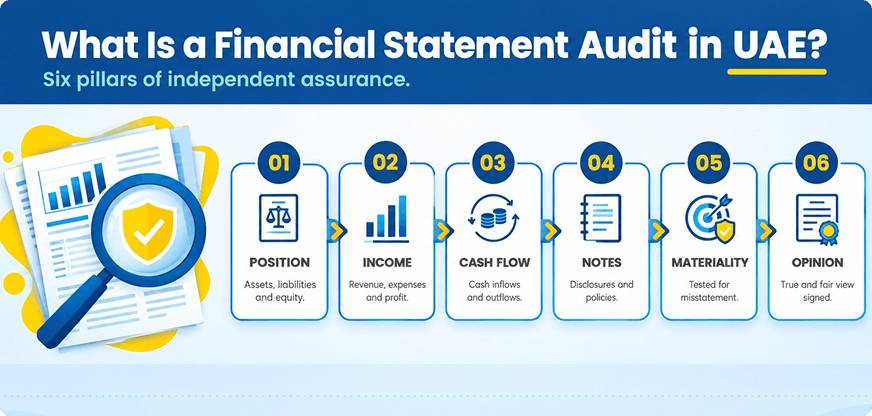
A financial statement audit that UAE businesses commission is an examination of the full set of financial statements: the statement of financial position, income statement, cash flow statement, and accompanying notes, covering a specific financial year. The auditor gathers evidence, tests transactions, and evaluates whether the statements as a whole are free from material misstatement, then the auditor expresses an opinion on whether they present a true and fair view in accordance with the applicable accounting standards.
What Does an Auditor Check?
An auditor gathers evidence on the areas most likely to contain material misstatement. Typical areas include:
- whether revenue is recognised in line with the applicable financial reporting framework and the disclosed accounting policy, and is supported by underlying contracts and invoices
- whether assets and liabilities are stated at appropriate values, with supporting reconciliations
- whether related-party transactions are identified and properly disclosed
- whether significant transactions and accounting estimates are supported by adequate documentation
- whether the financial statements are internally consistent as a whole, with the cash flow statement reconciling to the balance sheet and the notes supporting the figures in the primary statements
A financial statement audit also considers the laws and regulations relevant to the audit. These include requirements that directly affect the amounts and disclosures in the financial statements, and other requirements where non-compliance could have a material effect on them. A statutory audit is not a general compliance audit, however, and does not cover a company’s compliance with every licensing or regulatory obligation.
Audit and Assurance Services vs Accounting Services
Businesses sometimes assume their accountant and their auditor perform the same function, but the two roles are structurally different, and mixing them up creates both a compliance risk and, in some jurisdictions, an independence problem.
| Accounting Services | Audit and Assurance Services | |
| Who performs it | The company’s internal team or an outsourced bookkeeping and accounting provider | An independent, licensed external auditor |
| Purpose | Records transactions and prepares financial statements | Independently examines and forms an opinion on those statements |
| Relationship to the business | Ongoing, often embedded in day-to-day operations | Independent of the preparation process, by design |
| Output | Books of account, management reports, draft financial statements | A signed audit opinion or assurance report |
| Typical frequency | Continuous, throughout the year | Periodic, usually annual |
Auditor independence is the principle that separates these two functions, and it is a cornerstone of why an audit carries the weight it does. Management remains responsible for preparing the financial statements and for the internal controls behind them. The auditor’s role is to form an independent opinion on those statements. To do that, the auditor must comply with the applicable independence requirements, such as the IESBA Code of Ethics. These requirements include not holding a direct or material indirect financial interest in the client, and identifying and addressing threats to independence throughout the engagement. Those threats include any that arise from providing non-assurance services, such as accounting or bookkeeping support, to an audit client. Depending on the nature of the entity and the service, some non-assurance services require safeguards and others are not permitted at all. A business that wants both accounting support and an audit should therefore confirm early whether its auditor can provide both services, or whether it needs a separate provider.
What Are the Benefits of Assurance Services for UAE Companies?
Assurance services benefits extend beyond the statutory box-ticking that often drives the initial decision to engage an auditor. A well-executed assurance engagement gives management an independent, structured view of where the business’s financial processes are strong and where they need attention, well before those weaknesses show up as a bigger problem. It supports fundraising and financing conversations, since lenders and investors consistently weight audited or independently reviewed figures more heavily than unaudited internal numbers. It also creates a documented history that supports due diligence during a future sale, merger, or investment round, since buyers and investors move faster when a track record of independently reviewed financials already exists rather than having to reconstruct it from scratch.
How Do Audits Support Corporate Governance in UAE?
Corporate governance audit UAE practices rest on the idea that ownership and management are not always the same people, and that whoever holds ultimate authority over a business, whether a board, a set of shareholders, or a parent company, needs an independent check on what management reports to them. An audit provides exactly that check. It gives a board or shareholder group confidence that the financial information management is presenting has been independently tested rather than taken at face value, and it surfaces control weaknesses or governance gaps that internal reporting lines might otherwise obscure. For groups with more complex structures, including entities regulated under ADGM or operating under DIFC and DFSA regulation, this governance function often sits alongside additional regulator-specific reporting obligations that an audit engagement is designed to support directly.
What Is Audit Quality Assurance in UAE?
Audit quality assurance in the UAE refers to the systems and oversight that keep audit work itself reliable, both at the level of an individual audit firm and at the level of the profession as a whole. At the firm level, this means internal quality control procedures, partner review of audit files, and adherence to international auditing standards. At the regulatory level, the Ministry of Economy and Tourism’s Auditors Department licenses auditors and auditing firms and oversees their compliance with applicable legislation and professional performance standards, which functions as an external check on audit quality across the profession. A business choosing an audit provider is, in effect, relying on both layers, the firm’s own internal quality processes and the regulatory oversight sitting above them, to ensure the resulting opinion is dependable.
What Is the Audit Process for a UAE Business?
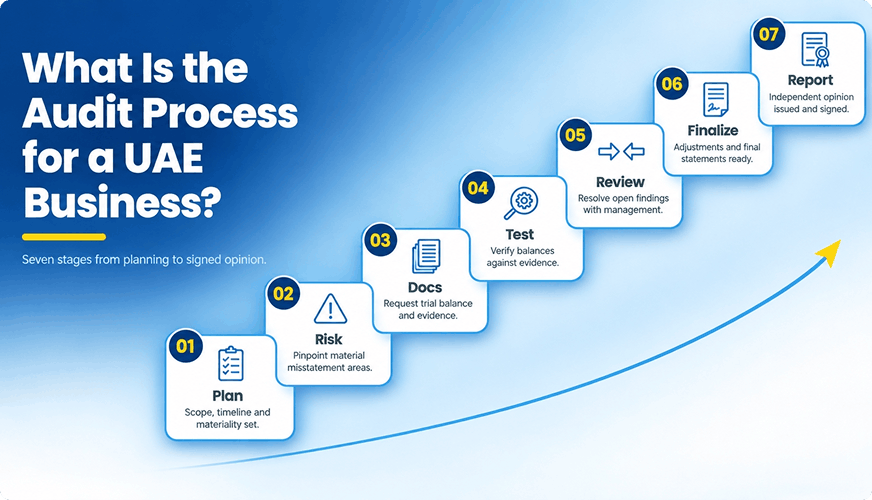
Step 1: Initial Planning. The auditor and the business agree on the scope, timeline, and materiality thresholds for the engagement, and the auditor gains an understanding of the business, its industry, and its accounting systems.
Step 2: Risk Assessment. The auditor identifies the areas of the financial statements most likely to contain a material misstatement, whether due to complexity, judgment, or history of errors, and designs the audit approach around those risk areas.
Step 3: Request for Documents. The auditor issues a request list covering the trial balance, supporting schedules, contracts, bank confirmations, and other evidence needed to test the figures in the financial statements.
Step 4: Audit Testing. The auditor performs substantive testing and control testing based on the risk assessment, verifying transactions and balances against underlying evidence rather than accepting management’s figures without corroboration.
Step 5: Review and Findings. The audit team reviews the testing performed, discusses any findings or proposed adjustments with management, and resolves open items before the statements are finalized.
Step 6: Financial Statement Finalization. Management incorporates any agreed adjustments, and the final version of the financial statements is prepared for signature.
Step 7: Auditor’s Report. The auditor issues a signed report expressing an opinion on whether the financial statements present a true and fair view in accordance with the applicable accounting standards, completing the engagement.
Which UAE Businesses May Need an Audit?
It would be inaccurate to say that all companies in the UAE must have audited financial statements. That overstates a picture that is more nuanced and depends on a company’s legal form and licensing authority. UAE Commercial Companies legislation contains provisions on auditors and audited accounts for companies within its scope, so mainland limited liability companies and joint-stock companies commonly need to appoint a licensed auditor and prepare audited accounts. Beyond this, many free zone authorities independently require audited financial statements as a condition of licence renewal.
The financial free zones add a further distinction between the authority a company is registered with and the regulator that oversees financial services. In ADGM, companies are registered with the ADGM Registration Authority, and firms carrying on regulated financial services are also supervised by the Financial Services Regulatory Authority (FSRA). In DIFC, companies are registered with the DIFC Registrar of Companies, and regulated financial services firms are supervised by the Dubai Financial Services Authority (DFSA). Entities regulated by the FSRA or DFSA often face additional audit and regulatory reporting requirements on top of the general company-law framework.
Corporate tax rules add another layer. Certain taxable persons, including Qualifying Free Zone Persons and businesses above specified revenue thresholds, need audited financial statements to support their corporate tax position, regardless of what their legal form otherwise requires.
Because these obligations stack differently depending on whether a business is set up through mainland company formation or a free zone business setup, and on the specific free zone or regulator involved, the reliable approach is to confirm a company’s actual obligations against its own legal form and licensing conditions rather than assume a single rule applies universally.
How Do Audit Requirements Differ Across UAE Free Zones?
The general audit obligation described above does not apply identically everywhere, since individual free zone authorities set their own conditions on top of the wider legal framework. Free zones including DMCC, JAFZA, RAKEZ, the Sharjah Airport International Free Zone, and DWTC each treat audited financial statements as a condition tied to license renewal, though the specific documentation requirements and submission process vary by authority. Entities regulated under ADGM or under DIFC and DFSA rules sit in a different category again, since their audit obligations come from financial services regulation rather than standard free zone licensing, and often carry additional reporting content beyond a standard financial statement audit. A business operating in more than one free zone, or considering a move between mainland company formation and a free zone business setup, should confirm the exact audit and filing conditions attached to its specific license rather than assuming the same timeline or documentation list applies across jurisdictions.
How Long Does a UAE Financial Audit Take?
Audit timelines vary enough by company size, record quality, and free zone or regulator requirements that a single number rarely holds true across every business, but a few factors consistently shape how long an engagement runs. A company with clean, reconciled records and a complete document set going into fieldwork typically moves through testing faster than one where the audit team has to chase missing schedules or resolve unreconciled balances along the way. Businesses with straightforward operations and a single jurisdiction generally complete an audit in a matter of weeks, while groups with multiple entities, related-party transactions, or regulator-specific reporting layers, such as those tied to ADGM or DIFC, tend to need more time for review and sign-off. Engaging an auditor with enough lead time before a filing or license renewal deadline, rather than right before it, gives a business the most reliable way to keep its own audit timeline under control.
How to Choose Audit and Assurance Services in UAE
Selecting the right provider matters as much as deciding to have an audit in the first place. A few factors are worth checking before committing to a firm: confirm the firm and its signing partner are licensed with the Ministry of Economy and Tourism’s Auditors Department, since this licensing is what makes the resulting opinion valid for statutory and regulatory purposes. Ask about the firm’s experience with businesses of a similar size, structure, and industry, since an auditor familiar with your specific sector asks sharper, more relevant questions during fieldwork. Confirm the firm maintains independence from any accounting or bookkeeping work performed for your business, since a conflict here undermines the value of the opinion itself. Review how the firm communicates during the engagement, since a provider that surfaces issues early, rather than only at the very end, gives management more time to address them properly. Finally, consider whether the firm can support related needs, such as tax advisory or broader regulatory compliance advisory, since a business’s audit, tax, and compliance positions are rarely fully separate from one another in practice.
Common Financial Reporting Problems an Audit Can Identify
An audit routinely surfaces issues that would otherwise go unnoticed until they became more serious: revenue recognized inconsistently from one period to the next without a documented reason, related-party transactions that were never properly identified or disclosed, fixed asset registers that no longer reflect actual disposals or impairments, receivables carried at values that no longer reflect their collectibility, weak segregation of duties around cash and payment approvals, and VAT or corporate tax positions that do not reconcile cleanly to the underlying accounting records. Catching these issues through an audit, rather than through an external event such as a bank review or a regulatory inquiry, gives management the chance to address them on its own terms.
How Audit and Assurance Build Stakeholder Trust
Stakeholder trust financial reporting depends on is not a single relationship; it is several different relationships, each of which relies on audited or independently assured figures for a different reason.
Investors rely on audited financial statements to evaluate a company’s actual performance and financial position before committing capital, and to track that performance against expectations after investing.
Lenders use audited figures to assess a business’s ability to service debt, and many facility agreements make ongoing access to financing conditional on continuing to provide audited or reviewed accounts.
Shareholders who are not involved in day-to-day management depend on an audit to confirm that the figures management reports to them can be relied upon, particularly where ownership and management are held by different people.
Management benefits from an audit as an independent check on its own internal reporting, catching errors or control gaps before they compound into larger problems.
Regulators, including free zone authorities and tax authorities, rely on audited financial statements to confirm a business is meeting its licensing and filing obligations accurately.
Business partners, including suppliers extending credit terms and companies considering a joint venture or acquisition, use audited financials to assess counterparty risk before committing to a relationship.
Common Mistakes to Avoid Before a UAE Financial Audit
Businesses preparing for their first, or next, UAE financial audit tend to run into the same avoidable issues: leaving reconciliations for major accounts unresolved until the auditor asks for them, rather than closing them out as part of routine monthly bookkeeping; failing to document the reasoning behind significant accounting judgments at the time they were made, which makes them much harder to explain months later; assuming that low activity or a quiet year means the audit will be quick, when incomplete documentation slows an audit regardless of transaction volume; treating the audit and the company’s tax filings as unrelated processes, when in practice a mismatch between the two is one of the fastest ways to trigger extra scrutiny; and engaging an auditor too close to a filing deadline, leaving no real time to resolve findings before the statements are due.
Bringing Confidence to Your Financial Reporting
Need greater confidence in your company’s financial reporting? KPI can help businesses evaluate their accounting and reporting requirements and access professional audit, assurance, and financial reporting support tailored to their UAE operations. Beyond audit and assurance, KPI supports UAE businesses with corporate tax services, VAT advisory, tax advisory, and broader regulatory compliance advisory for mainland and free zone entities, including businesses structured through JAFZA, DMCC, RAKEZ, the Sharjah Airport International Free Zone, and DWTC. Get in touch with our team to discuss your UAE audit and assurance needs.
Audit and Assurance Services UAE: Frequently Asked Questions
1. What are audit and assurance services in the UAE?
Audit and assurance services are independent examinations of a company’s financial information, performed by a licensed auditor, to confirm that the information can be relied upon. An audit is the most formal type, resulting in a signed opinion on the full financial statements, while assurance more broadly covers a range of engagements offering varying levels of independent verification.
2. Does every UAE business need an external audit?
Not automatically. Audit obligations depend on a company’s legal form and licensing authority. UAE Commercial Companies legislation contains provisions concerning auditors and audited accounts for companies within its scope; many free zone authorities independently require audited statements for license renewal, and regulated entities and certain corporate taxpayers face additional requirements. Confirming a specific company’s obligations against its own structure is more reliable than assuming a single universal rule.
3. What does a financial statement audit in the UAE include?
It covers an examination of the full set of financial statements for a given year, including testing revenue recognition, asset and liability valuations, related-party disclosures, and the overall consistency of the statements, concluding with a signed auditor’s opinion on whether they present a true and fair view.
4. How do audit services improve financial transparency?
Audits apply a consistent accounting framework, test figures against underlying evidence rather than accepting them at face value, require disclosure of significant judgments and related-party transactions, and produce an independent opinion that gives readers a clear basis for trusting the reported numbers.
5. What are the benefits of assurance services for UAE businesses?
Beyond meeting statutory or licensing requirements, assurance services give management an independent view of financial and control weaknesses, support financing and investment conversations by giving lenders and investors verified figures to rely on, and build a documented track record that speeds up future due diligence.
6. How can a company choose an audit firm in the UAE?
Confirm the firm and signing partner are licensed with the Ministry of Economy and Tourism’s Auditors Department, look for relevant industry experience, confirm independence from any accounting work performed for the business, assess how clearly the firm communicates during the engagement, and consider whether it can support related tax and compliance needs.
Disclaimer: This article provides general information about audit and assurance services in the UAE and does not constitute professional advice. Audit obligations vary by legal form, licensing authority, and individual company circumstances, and should be confirmed with a licensed auditor or the relevant regulatory authority before relying on them for a specific business.



Stay Ahead of the Curve
Subscribe for Expert Audit and Financial Insights Directly to Your Inbox.