

Business Insights, Industries Insights
How to Avoid the AED 10,000 Corporate Tax Penalty in the UAE
22 SEPTEMBER 2026 • 12 Min read
Missing a Corporate Tax registration deadline in the UAE can trigger a fixed AED 10,000 administrative penalty, regardless of whether the business actually owes any tax. The good news is that the Federal Tax Authority has introduced a waiver initiative that lets many affected businesses avoid or recover this penalty, though it comes with a specific condition that’s easy to miss if you’re not paying close attention.
This guide explains how to avoid the corporate tax penalty UAE authorities can impose for late registration, walks through exactly how the AED 10,000 penalty waiver works, and lays out a practical action plan depending on where your business currently stands. Corporate Tax rules, deadlines, penalties, and waiver conditions may change. Businesses should verify their specific obligations and current requirements with the Federal Tax Authority or a qualified UAE tax professional before acting on anything in this article.
What Is the AED 10,000 Corporate Tax Penalty in the UAE?
The AED 10,000 penalty is a fixed administrative fine issued under Cabinet Decision No. 75 of 2023, as amended by Cabinet Decision No. 10 of 2024, for failing to submit a Corporate Tax registration application within the FTA’s prescribed timeframe. It’s charged once per taxable person and applies automatically once the deadline is missed, regardless of intent, business size, or whether the business ultimately has any tax liability. Importantly, paying the penalty does not remove the obligation to register or to file returns; it simply addresses the late registration itself.
Who Needs to Register for UAE Corporate Tax?
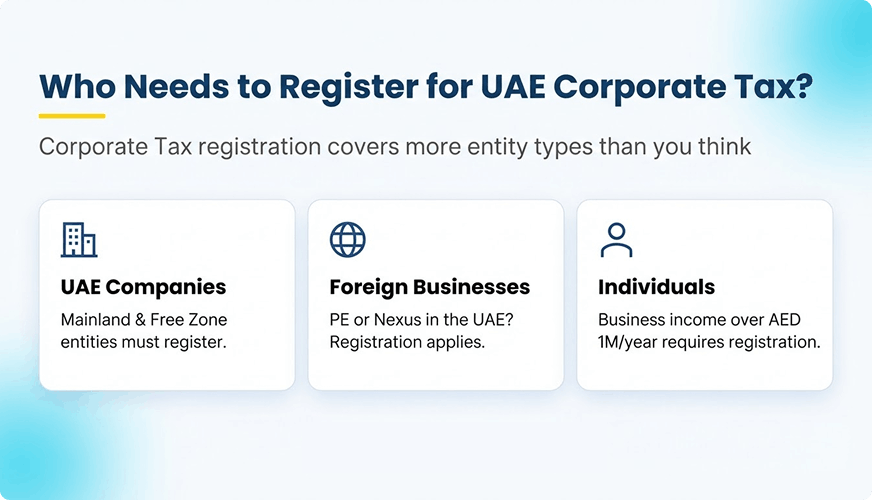
Corporate tax registration compliance obligations extend across a broader range of entities than many business owners assume.
UAE Juridical Persons
UAE-incorporated companies, including mainland and free zone entities, are generally required to register for Corporate Tax, with specific deadlines tied to their date of incorporation or licence issuance.
Foreign Businesses
Foreign entities that have a Permanent Establishment or a Nexus in the UAE are also subject to registration requirements, with rules that differ depending on how that presence is established.
Natural Persons
Individuals conducting business or business activities in the UAE also fall within scope in certain cases. The FTA currently states that a natural person is required to register when revenue from business or business activities exceeds AED 1 million within a calendar year, subject to exclusions specified by the FTA. This threshold and any related exclusions should be confirmed directly with the FTA, since natural person registration rules are one of the more commonly misunderstood parts of the Corporate Tax regime.
What Is the Corporate Tax Registration Deadline in the UAE?
Registration deadlines vary depending on the type of entity and, for UAE juridical persons, the month in which the licence was issued or the date of incorporation. Entities incorporated on or after 1 March 2024 are generally required to register within three months of incorporation. Because these deadlines are entity-specific and have shifted since Corporate Tax was introduced, businesses should confirm their exact deadline with a qualified tax advisor rather than relying on a generic date.
What Happens If You Register for Corporate Tax Late?
Missing the registration deadline generally results in the FTA issuing the fixed AED 10,000 administrative penalty. This penalty is separate from any penalties related to late filing of the Corporate Tax return itself, late payment of tax due, or inaccuracies in a filed return. In other words, resolving the registration penalty doesn’t automatically resolve every other compliance obligation still sitting in front of the business.
How to Avoid the AED 10,000 Corporate Tax Penalty
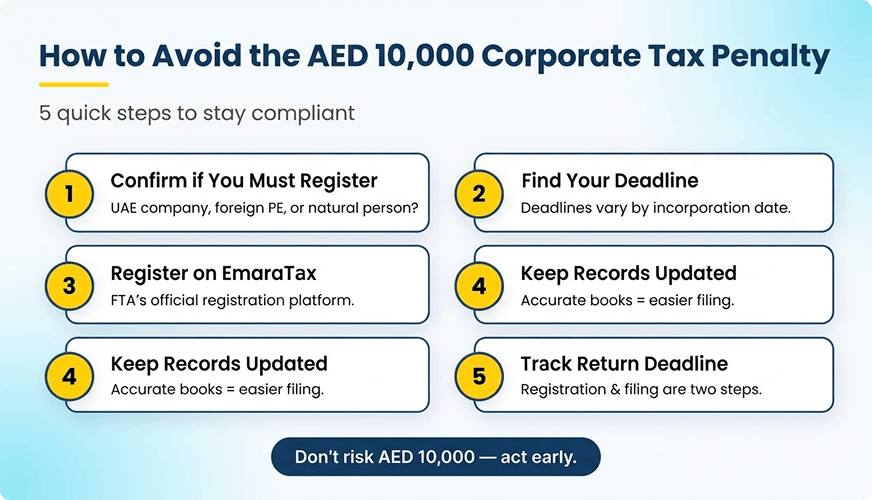
1. Determine Whether Your Business Must Register
Start by confirming whether your entity falls within scope, whether that’s as a UAE juridical person, a foreign business with a UAE presence, or a natural person exceeding the applicable revenue threshold.
2. Identify Your Registration Deadline
Deadlines differ by entity type and incorporation or licensing date, so confirm your specific deadline rather than assuming a general timeframe applies to your business.
3. Register Through EmaraTax
Registration is completed through the FTA’s EmaraTax platform. Businesses that haven’t yet registered, including those that missed their original deadline, should complete this step without further delay.
4. Keep Corporate Tax Records Updated
Accurate, current accounting records make it far easier to prepare an accurate first Corporate Tax return once the filing deadline approaches. KPI’s accounting services team helps businesses keep this foundation solid throughout the year, not just at filing time.
5. Track the First Tax Return Deadline
Registration and return filing are two separate compliance requirements with two separate deadlines. Missing the return deadline after registering doesn’t undo the registration itself, but it does expose the business to a different penalty, and as we’ll cover next, it can also affect eligibility for penalty relief.
What Is the UAE Corporate Tax Late Registration Penalty Waiver Initiative?
The FTA introduced a penalty waiver initiative that UAE businesses can benefit from, effective 14 April 2025, with retroactive application back to 1 June 2023, the date the Corporate Tax law came into force. The initiative was designed to support businesses transitioning into the new tax regime by allowing eligible taxable persons, and certain exempt persons required to register, to avoid or recover the AED 10,000 late registration penalty, provided they meet a specific filing condition tied to their first Tax Period.
Who Can Benefit From the AED 10,000 Penalty Waiver?
Businesses that registered late, or that have already been imposed the AED 10,000 penalty, may qualify for the waiver if they meet the FTA’s filing condition. It’s important to use the right language here: eligible businesses may qualify for the waiver, not that every business will receive one automatically regardless of circumstances. The waiver is conditional, tied specifically to timely filing of the first Corporate Tax return or annual declaration, and applies only to the taxable person’s first Tax Period.
How Does the AED 10,000 Penalty Waiver Work?
The core condition across all scenarios is the same: the taxable person, or exempt person required to register, needs to submit their Tax Return or annual declaration within seven months from the end of their first Tax Period, rather than the standard nine-month filing deadline.
Scenario 1: Penalty Issued but Not Paid. If the AED 10,000 penalty has already been assessed but not yet paid, filing the first Tax Return within the seven-month window can result in the penalty being waived, so it’s never charged in the first place.
Scenario 2: Penalty Already Paid. If the penalty has already been paid, meeting the same seven-month filing condition can result in the amount being credited back to the business’s FTA account.
Scenario 3: Business Has Not Yet Registered. Businesses that haven’t registered at all should register through EmaraTax immediately and then work toward filing their first Tax Return within seven months of the end of their first Tax Period to remain eligible for the waiver.
Is the AED 10,000 Corporate Tax Penalty Automatically Waived?
Not automatically in the sense of requiring no action. According to FTA guidance, eligible taxpayers generally do not need to submit a separate reconsideration or waiver request, but the waiver still depends entirely on meeting the seven-month filing condition. In practical terms, the business has to take the specific action of registering and filing the first return within the required window. Nothing is waived simply by the passage of time or by a business’s general intention to comply.
What If I Already Paid the AED 10,000 Penalty?
If your business has already paid the penalty, review when your first Tax Period ends and confirm the seven-month filing deadline that follows. Filing the first Tax Return or annual declaration within that window may make the business eligible for the amount to be credited back to its FTA account. If the seven-month window has already passed without the return being filed, it’s worth checking directly with the FTA or a qualified tax advisor on whether any relief options remain available for your specific situation.
What If I Have Not Registered for Yet?
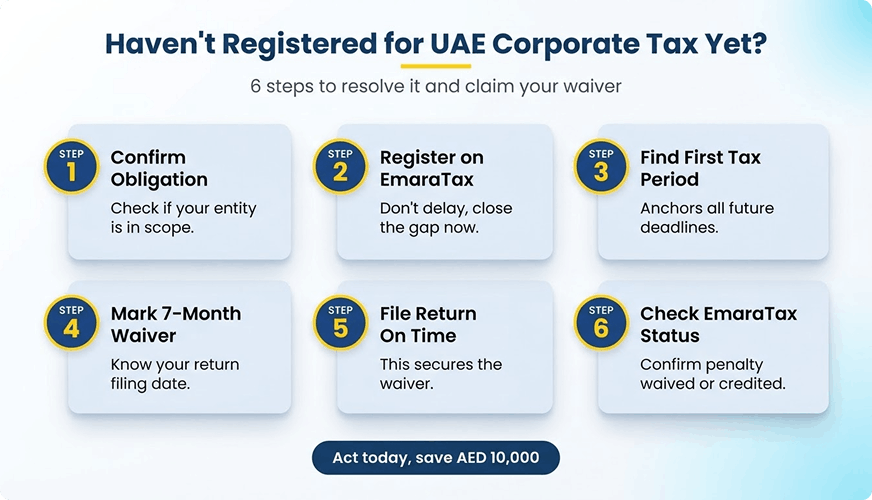
Step 1: Determine registration obligation. Confirm whether your entity is required to register based on its structure and activity.
Step 2: Register immediately through EmaraTax. Delaying registration further only extends the compliance gap and any associated risk.
Step 3: Determine the first Tax Period. This date anchors every subsequent deadline, including the seven-month waiver condition.
Step 4: Calculate the seven-month waiver condition where applicable. Mark the exact date your first Tax Return needs to be filed to remain eligible for the waiver.
Step 5: Prepare and submit the first Tax Return or Annual Declaration on time. This is the step that actually secures the waiver, not registration alone.
Step 6: Monitor the EmaraTax account for the penalty or credit status. Confirm that any applicable penalty has been waived or credited once the return has been filed.
Common Mistakes That Lead to Corporate Tax Penalties
Mistake 1: Assuming free zone companies are automatically exempt. Free zone status does not automatically mean a business can ignore Corporate Tax registration requirements. Free zone entities are still generally required to register, even where a 0% rate may eventually apply to qualifying income.
Mistake 2: Waiting until the Tax Return deadline. Registration and return filing are separate compliance requirements with separate deadlines, and treating them as one combined deadline is a common and costly assumption.
Mistake 3: Not identifying the first Tax Period. The first Tax Period anchors nearly every other deadline that follows, including the seven-month waiver condition, so getting this date wrong throws off everything downstream.
Mistake 4: Assuming the waiver is permanent. The waiver applies specifically to the first Tax Period under defined conditions. It is not a general exemption from future registration or filing penalties.
Mistake 5: Paying the penalty and ignoring the Tax Return. Paying the AED 10,000 penalty doesn’t resolve the underlying filing obligation, and without filing the first Tax Return within the required window, businesses may miss the chance to recover that payment.
Mistake 6: Relying on outdated articles. Corporate Tax rules and administrative penalty provisions can change, and a blog post written a year ago may no longer reflect current FTA guidance.
Mistake 7: Not monitoring EmaraTax. Businesses should regularly check their FTA account and notifications rather than assuming silence means everything is in order.
Corporate Tax Compliance Calendar for UAE Businesses
Monthly
- Maintain accounting records
- Capture invoices as they’re issued or received.
- Reconcile accounts against bank statements.
- Monitor business changes that could affect tax status, such as new shareholders or activities.
Quarterly
- Review the business’s overall tax position.
- Check registration and compliance status on EmaraTax.
- Update financial records to reflect the current quarter.
Annually
- Confirm the current Tax Period
- Prepare the Corporate Tax Return
- Check the applicable filing deadline.
- Pay tax due where applicable.
- Review registration information for accuracy.
Keeping this rhythm going year-round is far less stressful than trying to reconstruct a year of records in the weeks before a filing deadline.
How Businesses Can Build an FTA Penalty-Proof Compliance Process
A genuinely reliable compliance process usually combines a few consistent habits: accurate, up-to-date bookkeeping throughout the year, a clear internal calendar tracking every registration and filing deadline relevant to the business, someone specifically responsible for monitoring EmaraTax notifications, and a periodic review with a tax advisor to catch anything that’s changed in FTA guidance. Businesses that build this into their regular operating rhythm tend to avoid the last-minute scramble that leads to missed deadlines in the first place. KPI’s Corporate Tax compliance services are built around exactly this kind of ongoing structure.
When Should a Business Seek Professional Corporate Tax Support?
Professional support is worth bringing in when a business has missed its registration deadline and isn’t sure whether it still qualifies for the waiver, when the first Tax Period isn’t clearly established, when the business operates across multiple jurisdictions or entities with different deadlines, or when internal resources simply don’t have the bandwidth to track FTA deadlines alongside everything else running the business day to day. Given how much rides on getting the first Tax Period and the seven-month filing window right, this is one area where getting it wrong is considerably more expensive than getting advice early.
Conclusion
The AED 10,000 penalty is entirely avoidable with timely registration, and even businesses that missed their original deadline may still have a path to recovering or avoiding the penalty through the FTA’s waiver initiative. The condition is straightforward on paper: filing the first Tax Return within seven months of the end of the first Tax Period, but getting the underlying dates right and staying on top of the broader Corporate Tax calendar is where most businesses need support.
Let KPI Keep Your Corporate Tax Compliance on Track
Whether you’re still working out your registration deadline, trying to determine if you qualify for the penalty waiver, or simply want a compliance process that doesn’t rely on remembering dates manually, KPI’s Corporate Tax team handles registration, filing, and ongoing compliance for businesses across the UAE.
Alongside Corporate Tax support, KPI also helps businesses with:
- Mainland and free zone business setup for businesses still establishing their UAE presence
Get in touch with KPI today, and let’s make sure your business stays firmly on the right side of FTA deadlines.
FAQs
1. How can I avoid the AED 10,000 Corporate Tax penalty in the UAE?
Register for Corporate Tax through EmaraTax within your applicable deadline. If you’ve already missed it, register immediately and file your first Tax Return within seven months of the end of your first Tax Period to potentially qualify for the FTA’s penalty waiver.
2. Can the AED 10,000 Corporate Tax penalty be waived?
Yes, eligible taxable persons and certain exempt persons may qualify for a waiver if they submit their first Tax Return or annual declaration within seven months of the end of their first Tax Period, rather than the standard nine months.
3. What if I already paid the AED 10,000 Corporate Tax penalty?
You may be eligible to have the amount credited back to your FTA account if you file your first Tax Return within the seven-month window from the end of your first Tax Period.
4. What happens if I have not registered for Corporate Tax yet?
Register through EmaraTax as soon as possible, then confirm your first Tax Period and work toward filing your first Tax Return within seven months of its end to remain eligible for the penalty waiver.
5. Does the Corporate Tax penalty waiver apply automatically?
Eligible businesses generally don’t need to submit a separate waiver request, but the waiver still depends on actually meeting the seven-month filing condition. It isn’t granted simply by the passage of time.
6. How can UAE businesses avoid future FTA penalties?
Maintain accurate accounting records throughout the year, track registration and filing deadlines separately, monitor the EmaraTax account regularly, and work with a qualified Corporate Tax advisor to stay updated with FTA guidance.
Note: Corporate Tax rules, deadlines, penalties, and waiver conditions may change. Businesses should verify their specific obligations and current requirements with the Federal Tax Authority or a qualified UAE tax professional.



Stay Ahead of the Curve
Subscribe for Expert Audit and Financial Insights Directly to Your Inbox.