

DAFZA, DMCC, e-Invoicing Solution, Freezone & Offshore Setup, IFZA, JAFZA Freezone
UAE Free Zones and E-Invoicing: Designated Zones, Mainland Supplies, the Lot
09 SEPTEMBER 2026 • 6 Min read

UAE groups operating across mainland, free zone, and designated zone structures face a unique e-invoicing challenge: each entity classification carries distinct VAT treatment and PINT AE mapping requirements that can make or break compliance. As the UAE rolls out mandatory e-invoicing, businesses with entities in DMCC, JAFZA, RAKEZ, and other free zones must first nail down exactly how each entity is classified, since designated zone status, non-designated free zone rules, and mainland VAT treatment each demand different structured invoice handling. Getting this classification wrong doesn’t just create a compliance headache; it produces invoices that pass technical validation while being quietly incorrect on VAT, an error that often surfaces only during audit. This guide breaks down the three core classifications, how each behaves under e-invoicing, the intra-group and cross-border supply scenarios most finance teams underestimate, and a practical 90-day readiness roadmap for getting your PINT AE mappings right before your ASP conversations even begin.
UAE E-Invoicing: Mainland, Free Zone, and Designated Zone Compliance
Core UAE E-Invoicing Hurdles: Finalizing Group Entity Classifications Pre-Integration
A UAE group with even modest complexity will have at least one free zone entity, often three or four. Each of those entities has a specific tax classification that determines how its invoices behave under e-invoicing. And here’s the uncomfortable truth: a surprising number of finance teams are not 100% certain what classification each of their entities holds.
Before any ASP conversation, before any integration design, before any project plan, you need to answer one question per entity in writing: “Is this entity in a designated zone, a non-designated free zone, or mainland? And what does that mean for its supplies?”
This guide does not give you that classification (your tax advisor must, do so in writing). It does explain the framework, the e-invoicing implications of each classification, and the supply scenarios most groups underestimate.
Part 1: The three classifications that matter
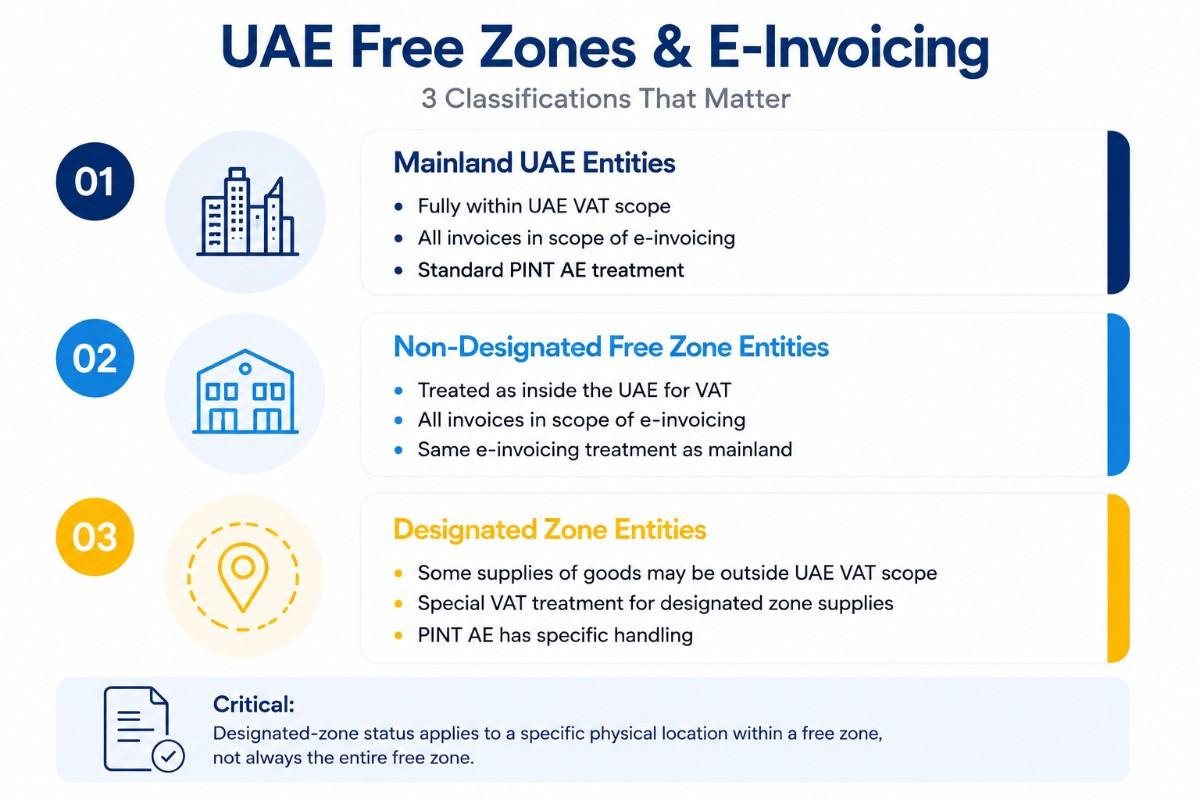
Classification 1- Mainland UAE entities
These are companies licensed and operating in mainland UAE (Department of Economy and Tourism in Dubai, Department of Economic Development in Abu Dhabi, etc.). They are fully within the UAE VAT scope, fully within the e-invoicing scope (subject to phasing).
Classification 2- Non-designated free zone entities
Most UAE free zones are non-designated for VAT purposes. Entities here are treated as being inside the UAE for VAT, meaning their supplies are subject to UAE VAT rules, and their invoicing is in scope of e-invoicing. The free-zone benefits (corporate tax, 100% foreign ownership) don’t change the VAT classification.
Examples typically include: most general-business free zones, technology and media free zones, and many specialized industry free zones.
Classification 3- Designated zone entities
A specific, smaller list of free zones is designated for VAT purposes. Supplies of goods within and between designated zones may be treated as being outside the scope of UAE VAT. This is the classification that creates the most invoicing complexity. Examples have historically included specific portions of certain free zones (with strict customs controls).
Critical point: designated-zone status applies to a specific physical location within a free zone, not always to the entire free zone’s entities. Two entities in the same free zone may sit in different classifications depending on their licensed location.
Part 2: How each classification behaves under e-invoicing
What changes per classification:
- Mainland: All invoices in scope of e-invoicing. Standard PINT AE treatment. Your back-office and ASP integration is the standard path.
- Non-designated free zone: All invoices in scope of e-invoicing. The supplies are treated as UAE-resident supplies for VAT. PINT AE handles these as standard. The free zone-vs-mainland distinction matters for tax law, but for the e-invoicing format, the path is the same as for the mainland.
- Designated zone: Some supplies of goods may fall outside the scope of UAE VAT, specifically, supplies of goods between designated zones or supplies of goods within a designated zone. These supplies still require invoicing, but the VAT classification is different. PINT AE has specific handling for designated-zone supplies. Your ASP must produce the structured invoice with the correct VAT treatment and the correct designated-zone indicators.
Mis-mapping a designated-zone supply as a standard taxable supply is the most common classification error we see in pre-go-live testing. The structured invoice will still validate, technically but the VAT amounts will be wrong, and the audit exposure is significant.
Part 3: The supply scenarios Groups underestimate
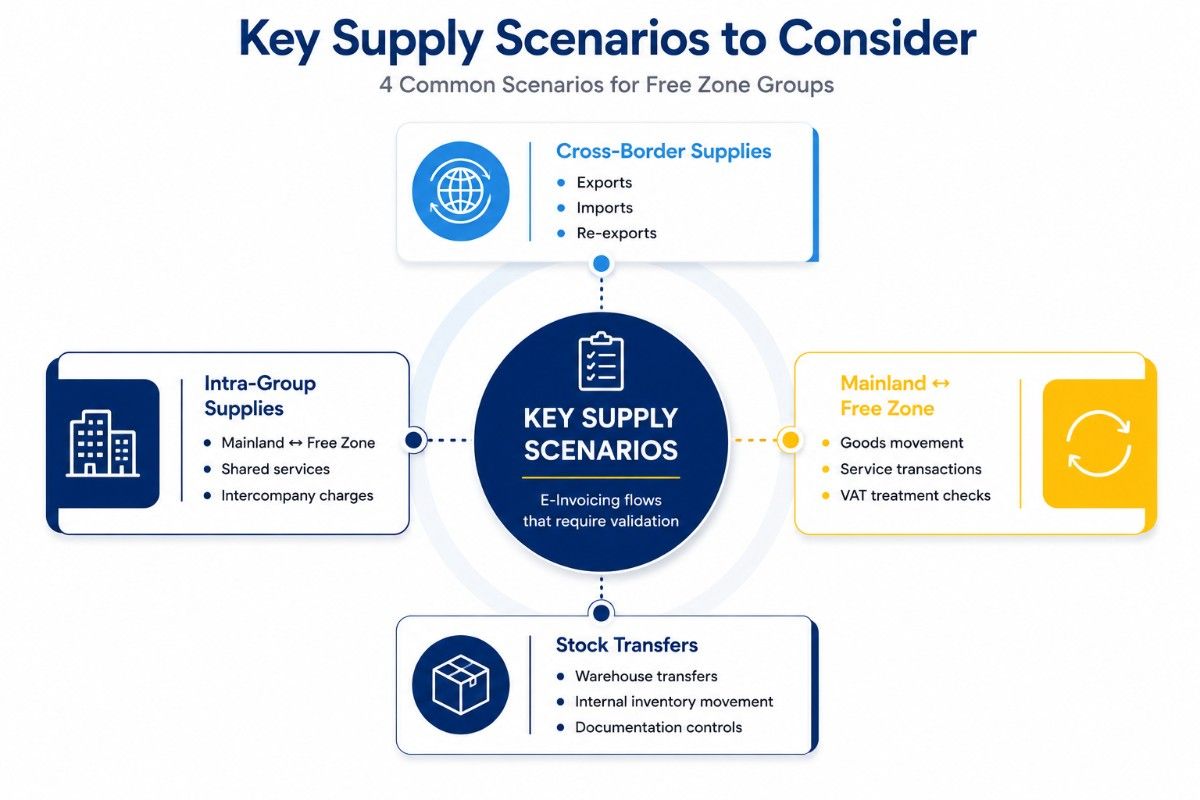
Scenario A: Intra-group supplies across classifications
A group with a mainland trading entity, a non-designated free zone services entity, and a designated zone logistics entity will be invoicing across all three internally: for management charges, shared services, and intra-group sales. Each of those internal invoices has a different VAT treatment depending on the directionality. Mapping these internal flows correctly into PINT AE is foundational.
Most groups under-test this because internal invoices feel “less critical” than external ones. Audit risk says otherwise.
Scenario: Supplies to non-resident customers
Free-zone entities (designated and non-designated) often supply to overseas customers. Export supplies have specific VAT treatment (zero-rated, subject to conditions). The structured invoice must reflect zero-rating correctly, capture export evidence indicators, and link to the supporting customs documentation.
The UAE PINT AE format automatically streamlines invoice data, simplifying processing for buyer finance teams. This ensures compliance and enhances efficiency in the invoicing workflow.
Scenario C: Reverse charge mechanism (RCM)
When your free-zone entity buys services from overseas suppliers, you generally apply VAT under reverse charge. The structured invoice you receive (or self-bill, depending on the model) must reflect RCM treatment correctly. Most groups have RCM controls in place for VAT returns, but the structured-invoice version of RCM is a less-tested flow.
Scenario D: Mainland-to-free-zone supplies
A mainland supplier invoicing a free-zone customer (or vice versa) treats the supply as a standard UAE VAT supply in most cases. But if the free-zone customer is in a designated zone and the goods are being supplied into the designated zone for use there, specific rules may apply. The structured invoice must reflect the correct treatment based on the goods destination, not just the customer entity’s location.
Part 4: The classification audits every group must complete
Before any e-invoicing integration work begins, complete this audit in writing, signed by your tax advisor:
- Every entity in your group, with its license type and licensed location.
- Classification per entity: mainland/non-designated free zone/designated zone.
- For designated zone entities: the specific zone, the licensed physical area, and confirmation that designated-zone treatment applies.
- Inventory of typical supplies for each entity: domestic, intra-group, export, RCM-inbound, designated-zone supplies.
- VAT treatment per supply type, signed off in writing.
- PINT AE field-level mapping convention per supply type: what indicator codes, VAT rate codes, and designated-zone flags get applied to each.
This audit must exist before you brief any ASP. The ASP will configure its platform based on what you tell them. If your classification audit is wrong, your configuration will be wrong, and the structured invoices will be technically valid but tax-incorrect.
Part 5: The free-zone-specific 90-day readiness plan
- Weeks 1-3: Classification audit (above) completed and signed by tax advisor.
- Week 4: Supply inventory per entity: what flows, in which directions, in what volumes.
- Weeks 5-6: Master data audit: customer and supplier classifications, with designated-zone flags where applicable.
- Weeks 7-8: ASP shortlist specifically demos designated-zone routing, intra-group flows, and RCM scenarios.
- Weeks 9-10: Configuration design PINT AE field mappings per classification + supply type.
- Weeks 11-12: Sandbox testing for each supply scenario across classifications.
One Wrong Classification, One Wrong Invoice
A designated zone entity mapped as a standard taxable supplier will still pass technical validation and still produce an invoice that is quietly wrong on VAT, and that gap tends to surface at audit rather than at go-live.
Before any ASP configuration begins, every mainland, free zone, and designated zone entity in your group needs a written classification that your finance team can build on. Whether your structure runs through DMCC, JAFZA, RAKEZ, RAK ICC, an offshore entity, or a broader free zone setup, KPI’s advisors have handled the formation side of these structures and know exactly where the e-invoicing complexity sits within them.
Pair that with our dedicated e-invoicing advisory services to get every entity’s PINT AE mapping right the first time. If your group spans multiple zones and you are not certain where each entity stands, get in touch with KPI here and get your classification audit underway before your ASP conversations begin.



Stay Ahead of the Curve
Subscribe for Expert Audit and Financial Insights Directly to Your Inbox.