

e-invoicing
The UAE E-Invoicing Readiness Playbook
10 JULY 2026 • 12 Min read

Six months out, here’s what separates the companies that’ll glide from the ones that’ll scramble.
It’s Thursday morning in Dubai. A CFO walks into a conference room she’s booked for two hours.
On the table: a printout of the FTA’s e-invoicing framework. A list of fourteen ERPs, accounting systems, and POS tools spread across her company’s twelve entities. A draft note from her auditor asking for the third time about her ‘readiness plan’.
She sits down. She breathes. She opens a notebook.
And she writes one word at the top of the page: Where?
Where do I start?
Suppose that question is sitting on your desk too — congratulations. You’ve just done what 70% of UAE finance leaders haven’t done yet: acknowledged that this is real and that it needs a plan.
And the cost of not having one is no longer abstract. Under Cabinet Decision No. 106 of 2025, businesses that fail to implement e-invoicing or appoint an Accredited Service Provider face a penalty of AED 5,000 for every month of delay, on top of AED 100 per e-invoice or credit note not issued or transmitted on time (capped at AED 5,000 a month). That’s the real reason ‘we’ll get to it next quarter’ is no longer a safe answer.
Over the next 16 minutes, we’ll walk through the only playbook you need to get your business ready for e-invoicing in the UAE. It’s built from real engagements on what worked, what hurt, what saved time, and what cost money.
Saudi Arabia. India. Malaysia. And now, the UAE.
Here’s what we’ll cover:
- Why most readiness frameworks fail (and what works instead)?
- The five honest phases of a UAE e-invoicing program
- Phase 1- Diagnose (Weeks 1–3)
- Phase 2- Design (Weeks 4–7)
- Phase 3- Build (Weeks 8–14)
- Phase 4- Rehearse (Weeks 15–18)
- Phase 5- Go-Live and Stabilize (Weeks 19+)
- The seven mistakes that quietly kill these programs
- The four roles that must exist (even if you don’t have them yet)
- What success looks like 90 days post-go-live
Why Most Readiness Frameworks Fail
Walk into any Big-4 boardroom, and you’ll see the same slide. A horizontal timeline. Six neat phases. Lots of arrows. Phrases like ‘Discover’, ‘Mobilize’, ‘Realize’.
The slide is fine. The execution is the problem.
Most frameworks fail because they’re written for a project that exists on paper, not a business that exists in real life. They assume:
- You have a clean view of all your invoice types. (You don’t.)
- Your ERP is well-configured and well-documented. (It isn’t.)
- Your AP team has the capacity to take on a transformation. (They don’t.)
- You’ll get six clear months of focused attention. (You won’t.)
- Your auditor and your IT vendor are aligned. (They’re not.)
This playbook accounts for actual business constraints. It is built specifically for UAE leaders managing limited time, stretched IT departments, and immediate regulatory demands.
Here is the playbook.
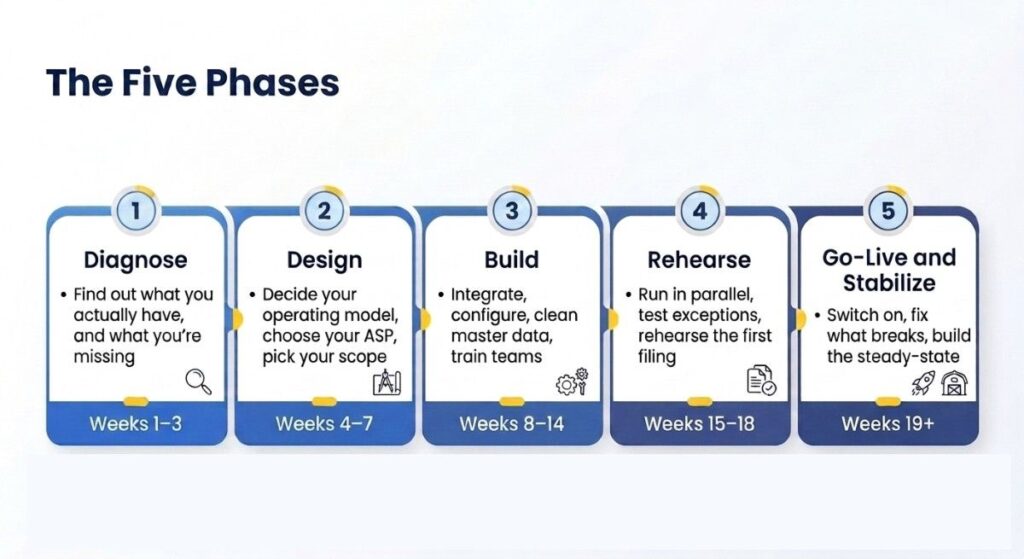
The Five Phases
Forget the jargon-laden ‘transform-and-realize’ frameworks. Here’s what actually happens in a UAE e-invoicing rollout:
| Phase | What it covers | Duration |
| 1. Diagnose | Find out what you actually have, and what you’re missing | Weeks 1–3 |
| 2. Design | Decide your operating model, choose your ASP, pick your scope | Weeks 4–7 |
| 3. Build | Integrate, configure, clean master data, train teams | Weeks 8–14 |
| 4. Rehearse | Run in parallel, test exceptions, rehearse the first filing | Weeks 15–18 |
| 5. Go-Live and Stabilize | Switch on, fix what breaks, build the steady-state | Weeks 19+ |
Total elapsed time, end-to-end: 4–6 months for most UAE businesses. Less for the very simple. More for groups with multiple entities, multiple ERPs, or significant cross-border trade.
Phase 1 – Diagnose
Most companies skip this. That’s the single biggest reason their projects fall apart later. Diagnosis is cheap. Skipping diagnosis is expensive.
Step 1- Inventory your invoice types
In week one, list every type of invoice your business issues. Not the volume yet. Just the types.
A typical UAE mid-sized business has more than they think.
- Standard B2B invoices.
- Intercompany invoices.
- Exports (zero-rated).
- Reverse charge invoices.
- Advance payment invoices.
- Credit notes. Debit notes.
- Milestone invoices.
- Annual prepayments.
- Cash sales.
- POS receipts at scale.
- Customs-related documents.
If you stop counting at five keep counting. The number we usually arrive at, with a real workshop, is between 12 and 20. Every one of them has slightly different e-invoicing implications. Intercompany within the same VAT group has a grace period until 31st December 2028.
Step 2- Inventory your invoicing systems
Now the systems. List every place an invoice gets generated in your business. ERPs. Standalone billing systems. POS tools.
Include the workarounds, too, like the custom Excel sheet used for that one unique account, or recurring quarterly revenues.
The goal here isn’t to clean up the data yet. It is simple to see it. Every time a company runs this audit, the CFO discovers invoicing sources they had no idea existed.
Step 3- Inventory your AP reality
This is the one most companies miss entirely. Where do your supplier invoices come in?
And it’s not only an operational question. On the receiving side, connecting to your own Accredited Service Provider isn’t optional, it’s mandatory under the UAE model. A compliant e-invoice from a supplier has to reach you through an ASP-to-ASP connection, not as a PDF in your inbox or a paper copy your team keys in by hand. So before you count how many invoices get manually retyped, confirm whether your AP function can even receive a compliant e-invoice yet. That’s a bigger gap than the retyping problem, and it’s the one most readiness plans miss.
- Email? Portal? Physical post (yes, still)?
- How many suppliers?
- How many invoices a month?
- How many different formats?
Then ask the harder question: how many of those invoices currently get manually retyped into your ERP? Be honest.
The honest answer, in most UAE mid-market businesses, is ‘most of them’.
That single metric defines your entire AP transformation.
Step 4- Quick capability assessment
Rate your organization honestly from 1 to 5 across four key dimensions:
- Process Maturity: How standardized are your invoice workflows today?
- Technology Readiness: How modern, integrated, and well-documented is your IT architecture?
- Data Hygiene: How accurate is your master data across customers, suppliers, items, and tax codes?
- Team Capacity: How much realistic bandwidth do your finance, IT, and operations teams have?
Your total score will give you a clear, realistic picture of how heavy the upcoming implementation phases will be.
Phase 2 – Design
Now you choose. This is the decision-heavy phase. Move fast or it stalls.
Decision 1 – Centralized or decentralized?
Big groups face this fork. Do you run e-invoicing centrally: one ASP, one integration layer, one governance, or do you let each entity manage its own setup?
We almost always recommend centralized. Cheaper, cleaner, more controllable, more auditable. Decentralized feels easier on day one and costs you for years.
Decision 2 – Which ASP?
This is the single most important decision of the whole program. Get it right, and the next 12 months are quiet. Get it wrong, and you’ll switch ASPs by month 18 — at a painful cost.
We’ll go deeper on this in our companion piece. For now, the principle: pick on integration quality, regulatory track record, and depth of support — not on the cheapest quote.
Decision 3 – Project Governance and Conflict Resolution
E-invoicing initiatives inherently trigger cross-functional conflicts due to overlapping technical, operational, and regulatory priorities. Misalignment frequently arises between internal stakeholders and external advisors:
- IT vs. Tax: Prioritizing software architecture versus securing strict regulatory compliance.
- Finance vs. Operations: Balancing cash flow reporting requirements against daily business transaction speed.
- Auditors vs. Consultants: Managing strict legal risk mitigation versus fast-tracked implementation schedules.
Establishing a clear governance framework with a designated decision-maker prevents deadlocked discussions, ensures continuous project momentum, and guarantees a single accountability point for final approval.
The Technical Layer: PINT AE, Peppol, and the Scenarios Your ERP Needs to Handle
Underneath the ASP decision sits a data standard, and it’s worth knowing before you sign anything. UAE e-invoices run on PINT AE, the UAE’s own specialization of the Peppol International (PINT) invoice model, published by the Ministry of Finance in its role as the UAE’s Peppol Authority. It defines the exact data structure, code lists, and validation rules every invoice has to pass before it reaches the FTA through the five-corner network: your ASP, your counterparty’s ASP, and the FTA sitting on the data feed for real-time tax monitoring.
That structure comes with mandatory fields, not optional ones: the TRN for both supplier and buyer, a Peppol electronic address, invoice type and tax category codes, line-level tax classification, and totals in AED, among others. Get these wrong in Build and every invoice bounces.
And the standard doesn’t stop at the simple case. Ask your ASP and your ERP integrator, explicitly, how they handle:
- Free zone invoices: Qualifying Free Zone Person (QFZP) transactions carry their own scenario and zone identifiers.
- Zero-rated exports: still a full e-invoice, still on tax category code Z, despite the 0% VAT.
- Summary invoices: consolidating multiple supplies to one buyer over a set period into a single e-invoice.
- Self-billing: the buyer issues the invoice, and the credit note, on the supplier’s behalf, under a pre-agreed written arrangement.
- Credit notes: must reference the original invoice and trigger the matching VAT adjustment, including the self-billed variant.
If your vendor can’t answer these in a scoping call, that’s your answer on whether they’re ready.
Phase 3- Build
This is where most of the visible work happens. Integration. Configuration. Master data cleanup. Training. It looks like a busy phase. It is.
Master data — the silent project
Underneath every successful e-invoicing rollout is a master data cleanup. Customer master fixes. Supplier master fixes. Tax code rationalization. Item master normalization.
This is unglamorous, unappealing, or painful, and absolutely critical. Budget 4–6 weeks of effort. Find someone, usually a senior AR or AP supervisor, who knows the data intimately. Empower them. Pay them more if you have to. They’re the unsung hero of the program.
System Integration: Managing Timelines
Vendor timelines usually only cover basic technical setup. They do not account for data errors, system failures, or business continuity.
To ensure project success, allow extra time for three critical steps:
- Data Mapping: Aligning your current system fields with strict tax regulations.
- Error Handling: Testing how the system manages rejected or failed invoices.
- Retry Mechanism: Creating a backup plan if the network goes down.
Double the vendor’s estimated timeline to build a realistic project schedule.
There’s a piece most e-invoicing playbooks skip: your ERP itself. It’s treated as a fixed variable, something you integrate around, not something you fix. That’s a mistake. If your ERP is outdated, poorly configured, or was never built for real-time tax reporting, e-invoicing is what exposes it, usually mid-Build, when it’s the most expensive point to unwind. A quick ERP readiness check before Build starts, not during it, is what separates a clean integration from a scramble.
This is also where Vantheon Technologies, KPI Group’s technology arm, comes in. Vantheon Technologies provides ERP and NetSuite implementation services for UAE and GCC businesses, making sure the system underneath your e-invoicing integration is actually ready to carry it.
Training – start earlier than you think
By the time integration is done, you should already have trained your AR team on the new flow. And your AP team. And, your sales team on what they can and can’t promise to customers.
Phase 4 – Rehearse
Almost no one rehearses properly. The ones who do go live without incident. The ones who don’t learn what ‘panic’ really looks like.
Run a parallel month
For at least four weeks before go-live, issue invoices both ways your old way and the e-invoicing way. Compare. Spot the differences. Reconcile.
Yes, it’s double work. Yes, it’s expensive. But it’s worth every dirham.
Rehearse the exceptions
What happens when an invoice doesn’t get validated by the FTA? Who picks it up? How does it get re-submitted? How is the customer informed? Run the scenario. Time it. Fix the slow points.
The first real rejection in production is not the time to figure this out.
Rehearse your first filing cycle
Many companies focus on the day-to-day and forget the month-end. Walk through, end-to-end, what the close cycle looks like with e-invoicing live. Adjustments, reconciliations, returns filing, audit pulls.
Phase 5- Go-Live and Stabilize
You’re live. The world doesn’t end. But it does get noisy.
Anticipate and plan for two to four weeks of elevated activity:
- Higher-than-normal rejected invoices as edge cases surface
- Customer queries about formatting and delivery
- Supplier queries about how they should now invoice you
- Internal queries from AR and AP about exception scenarios
- Reporting questions from finance leadership (‘is it working?’)
Plan for a war-room model for the first 30 days. A daily 15-minute stand-up between finance ops, IT, and tax. Quick decisions. Tight feedback loops.
By day 60, the war-room shrinks to a weekly check-in. By day 90, you’re in steady state. That’s the goal.
The Seven Mistakes That Quietly Kill These Programs
- Auditor Ownership: Auditors flag compliance risks, but they should not lead project execution. Let Operations or IT drive the project.
- Price-Driven Selection: The cheapest Accredited Service Provider (ASP) today often becomes the most expensive due to hidden transaction fees, poor support, and integration errors over three years.
- Delayed Data Cleanup: Master data errors (like missing tax IDs or incorrect addresses) must be fixed during the build phase. Postponing this step guarantees immediate invoice rejections by the government system.
- Overlooking Accounts Payable (AP): Implementing e-invoicing is not just an IT project. It completely changes how your AP team processes incoming supplier bills.
- Skipping Parallel Runs: Skipping a dual-system trial to save four weeks pre-launch will cost you twelve weeks of chaos solving system failures live in production.
- Indecisive Committee Structure: Relying on consensus governance stalls momentum. A single named decision-maker must be appointed to resolve cross-functional disputes between Tax, IT, and Finance.
- Premature Project Closure: Ending the project on launch day introduces heavy risk. The first 90 days require hyper-care support to handle system exceptions, vendor errors, and government validation failures.
The Four Roles That Must Exist
Even if you don’t have them yet, name them now. These four roles must be filled by individual humans for the program to succeed.
| Role | What they do | Time commitment |
| Sponsor | Owns the budget, the politics, and the deadline. Usually CFO or COO. | 2 hrs/week |
| Program Lead | Runs day-to-day. Holds the plan. Owns the steering. Often Finance Transformation or Group Controller. | 20+ hrs/week |
| Tech Lead | Owns systems, ASP relationship, integration, master data. Often IT Head or senior IT manager. | 15 hrs/week |
| Ops Lead | Owns AR + AP redesign, training, exception handling, customer/supplier comms. Often AR/AP Senior Manager. | 15 hrs/week |
What Success Looks Like 90 Days Post-Go-Live
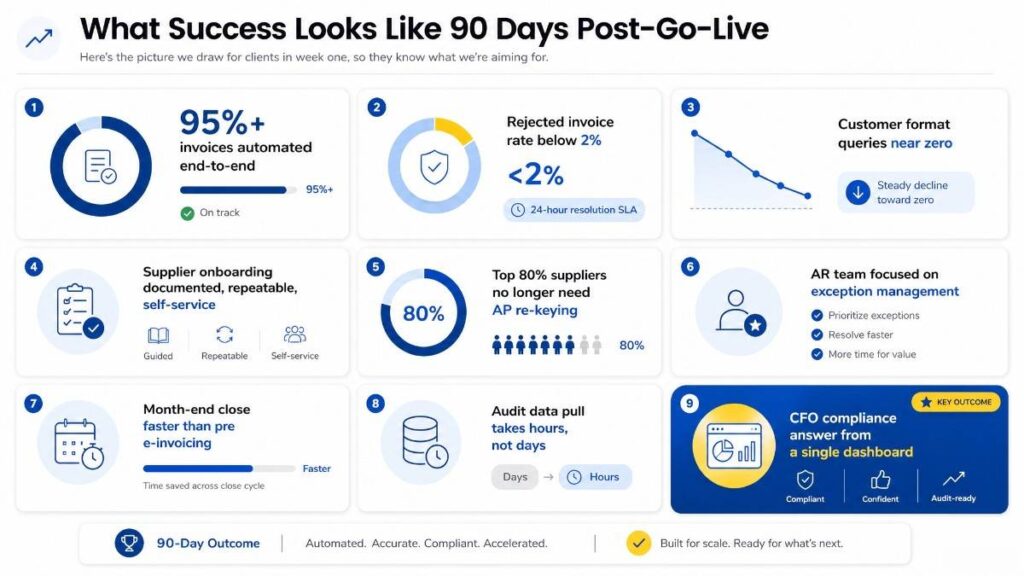
Here’s the picture we draw for clients in week one, so they know what we’re aiming for.
By day 90:
- More than 95% of invoices flowing automatically end-to-end, no manual touch
- Rejected invoice rate below 2%, with a defined 24-hour resolution SLA
- Customer queries about e-invoicing format have dropped to near zero
- Supplier onboarding is documented, repeatable, and largely self-service
- Your AP team has stopped re-typing invoices for at least the top 80% of suppliers
- Your AR team has shifted from ‘invoice production’ to ‘exception management’
- Month-end close is faster than before e-invoicing, not slower
- Your audit data pull for the period takes hours, not days”
- Your CFO can answer the auditor’s ‘Are you compliant?’ question with a single dashboard
If your day-90 doesn’t look like this, the program isn’t done. Stabilize harder. Don’t move on.
A Final Word and Why This Playbook Exists
Next Steps: Moving from Planning to Execution
E-invoicing implementations across regional markets follow a predictable learning curve. Successful deployments rarely depend on budget or technology alone; they rely on a structured plan and strict operational discipline.
With the framework established, immediate next steps include:
- Finalizing Governance: Confirming your named project decision-maker.
- Securing Resources: Extending the project team’s timeline for the 90-day post-launch support phase.
- Initiating Data Cleanup: Beginning vendor master data remediation immediately.
Get UAE E-Invoicing Ready with KPI’s Compliance Experts
Staying compliant with the UAE’s upcoming e-invoicing mandate doesn’t have to be overwhelming. KPI’s team helps businesses across the UAE prepare for tax digitization with tailored ERP implementation and VAT and tax compliance solutions built for local regulations. Whether you need to integrate e-invoicing into your existing systems or streamline your entire financial workflow, our business digital overview services ensure a smooth, penalty-free transition. Don’t wait until the deadline arrives contact our UAE compliance team today and get a customized readiness assessment for your business.



Stay Ahead of the Curve
Subscribe for Expert Audit and Financial Insights Directly to Your Inbox.