

e-invoicing, e-Invoicing Solution, VAT Services
E-Invoicing for UAE Construction: RA Bills, Retention, Sub-contractors, and the Operational Reality
11 SEPTEMBER 2026 • 5 Min read

E-Invoicing for UAE Construction: RA Bills, Retention, Sub-contractors
Construction finance runs on flows no other industry uses. Here’s how each of them is reshaped by e-invoicing and the operational specifics that no generic implementation guide covers.
Construction is the industry where the standard “issue invoice, get paid in 30 days” model breaks down completely. A contractor on a 24-month project doesn’t issue an invoice — they issue a sequence of RA bills (Running Account bills) as work progresses, each one a partial draw against the contract value, each subject to a complex set of approvals, deductions, and retentions.
Sub-contractors operate the same way one level down. Material suppliers may be invoicing on standard 30-day terms. The project manager certifies progress. The consultant approves payment. The client may not pay for 60–120 days after certification. Retention sits in the project ledger for 12-24 months after completion.
Every one of these flows must now be reflected in structured electronic invoices. None of them is standard.
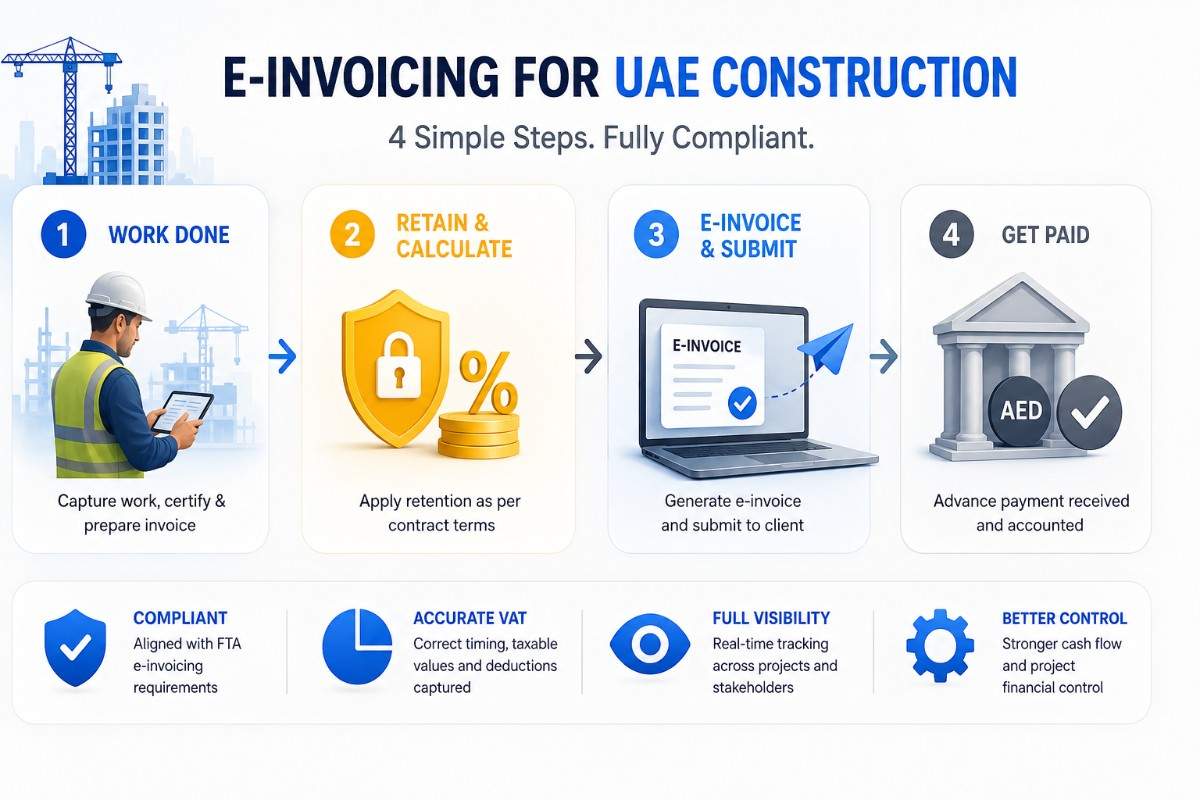
Flow 1: Running Account (RA) bills
- A Running Account (RA) bill is a contractor’s periodic claim for work done. Each bill is cumulative (e.g., RA-3 shows total work to date minus previous payments). Under UAE e-invoicing, every RA bill must follow a strict structural format:
- Standard Treatment: Each RA generates a digital tax invoice showing three data points: the gross value of work in that period, the cumulative project position, and the final net payable amount.
- Variation Handling: Any contract changes, such as additions, omissions, or change orders, must be captured inside the structured invoice to maintain a clear audit trail per RA.
- Line-Level Deductions: The PINT AE schema allows for line-level deductions. You must configure your system to explicitly account for advance recoveries, client-supplied materials, and site contra-charges that lower the net payable.
- Certificate-Driven Dates: If your contract dictates invoicing based on the consultant’s payment certificate rather than the RA bill itself, your back office must use the certification date as the official tax invoice date, not the work completion date.
Flow 2: Retention
Retention is the portion of each RA that the client withholds (typically 5–10%) as security for defect liability. Half is usually released on substantial completion; the rest after the defect liability period (typically 12 months).
What changes under e-invoicing:
- Retention held on each RA is NOT a separate invoice. It’s a line-level deduction on each RA invoice. The structured invoice format handles this line item: full value, retention deduction line, net.
- When retention is released, typically on a “retention release certificate”, a separate tax invoice is issued for the retention amount. This invoice is the contractor’s claim for previously held funds. It must reference the original RA invoices it relates to (or at least the project/contract). The audit chain must be unambiguous.
- VAT on retention timing: VAT was historically due when the original RA was issued (at the gross value, before retention deduction). E-invoicing preserves this. But the structured invoice format must capture both the gross value (taxable) and the cash-flow value (net of retention). Misconfiguration here under-reports VAT in real-time.
- During the 12-month defects liability period, contractors must issue compliant credit notes for any post-completion adjustments, such as repair costs, dispute resolutions, or partial retention forfeitures. Under PINT AE rules, each credit note must be electronically linked back to its original parent tax invoice to maintain a clear audit trail.
Flow 3: Sub-contractor and material supplier inbound
A main contractor isn’t just issuing invoices outward; they’re receiving them from sub-contractors and material suppliers in continuous volume. Sub-contractor invoices come in on similar RA-bill structures. Material suppliers may issue standard invoices, but matching them to the project/cost code/progress is the contractor’s reconciliation problem.
AP-side implications:
- Every sub-contractor must invoice the main contractor through their own ASP. The main contractor receives structured PINT AE invoices through their own ASP. Validation, matching, and posting happen against project cost codes.
- Material supplier invoices need to match the goods received note (GRN), the purchase order, and the work-in-progress allocation. Three-way matching has always been the standard; e-invoicing makes the data structured, which makes the matching faster if the master data is clean.
- Disputed sub-contractor invoices generate credit notes or holdback invoices. Each must be properly captured in the audit trail.
- Project-cost-code linkage is the discipline that separates contractors that thrive under e-invoicing from those that drown in reconciliation. PINT AE has fields for buyer reference codes; using them properly for project linkage is foundational.
Flow 4: Advance payments, mobilization, and project-financing flows
Contractors often receive advance payments (mobilization advances, material advances, interim advances) before commensurate work is done. These advances are recovered through deductions on subsequent RA bills.
Under e-invoicing:
- An advance payment generates a tax invoice at the time of receipt (advance payment invoice). The structured invoice must reflect that it’s an advance, with the appropriate indicator.
- Recovery of the advance on subsequent RAs is a line-level deduction on those RA invoices. The link between the original advance invoice and the recovery deductions must be auditable.
- Bank guarantees, performance bonds, advance payment bonds: these are financial instruments, not tax invoices, but the bond charges may generate separate invoices that need to flow through the structured channel.
A construction-specific 90-day readiness plan
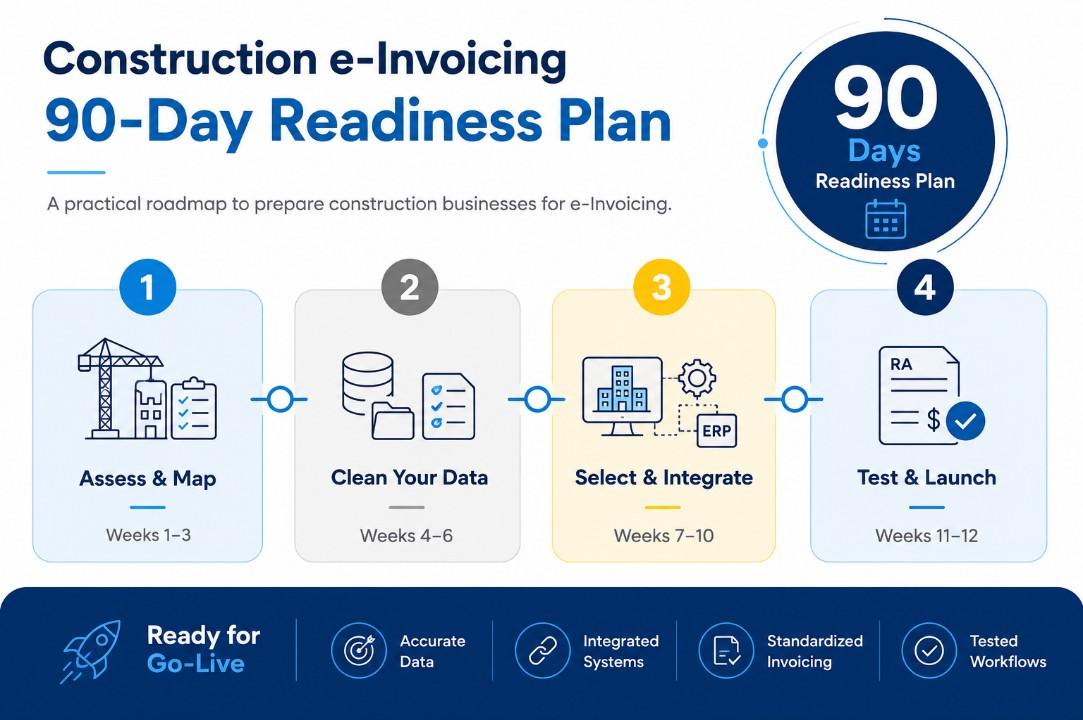
- Weeks 1-2: Inventory every project active, in defects period, in retention period. Confirm contract structures (lump sum, remeasurement, design-build).
- Week 3: Map invoice flows per project type: RA bills, retention releases, advance recoveries, and variations.
- Weeks 4-5: Master data audit client TRNs (project owners), sub-contractor and supplier master data, cost-code structure.
- Week 6: Decide on your “certificate-driven vs RA-driven” invoicing convention and stick to it across projects.
- Weeks 7-8: ASP shortlists with construction-specific demos: RA structures, retention deductions, advance recoveries, and three-way matching.
- Weeks 9-10: Integration design accounting/ERP/project management system integration with ASP.
- Weeks 11-12: Sandbox testing using real RA bill data from completed projects.
Your RA Bills Shouldn’t Be a Guessing Game
Every RA bill, retention release, and sub-contractor invoice carries VAT implications that generic e-invoicing checklists simply don’t account for. KPI’s VAT Advisory Services team has spent years untangling exactly these construction-specific structures for contractors operating across the UAE.
Whether you need to map your RA-to-retention audit trail through our dedicated E-Invoicing advisory practice or build the Standard Operating Procedures that keep project cost codes clean through the transition, our team designs the framework around how your projects actually run, not how a generic template assumes they should.
Contact KPI to get your 90-day readiness plan moving before your next RA cycle falls due.



Stay Ahead of the Curve
Subscribe for Expert Audit and Financial Insights Directly to Your Inbox.