

e-invoicing, e-Invoicing Solution
The CFO’s First 30-Days E-Invoicing Checklist
16 JULY 2026 • 5 Min read

Most UAE CFOs we speak to don’t need another article telling them e-invoicing is coming. They know. What they need is a sequence of what to do on Monday morning, then Wednesday, then next week, then the week after.
That doesn’t require buying anything, hiring anyone, or making any irreversible decisions yet.
Below is that sequence. It’s 30 days of structured readiness work, owned by the CFO, designed to get you from “we should do something about this” to “we have a plan, a scope, a budget, and a vendor shortlist.” We’ve summarized the framework in this article. The full day-by-day version. is available as a PDF download at the end of this piece.
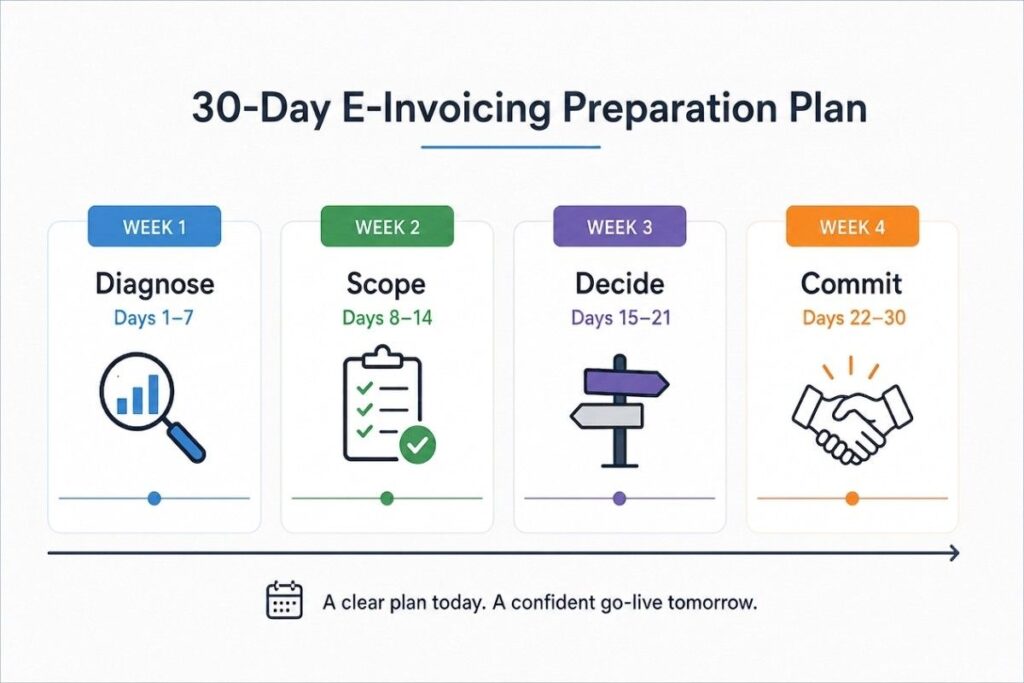
Week 1: Diagnose (Days 1–7)
The goal of Week 1 is not to start a project. It’s to know what you’re looking at.
Day 1: Send four emails
To your IT head, Finance Director, Tax Manager, and Operations Lead. One sentence each: “Please send me a list of the three invoice-related processes you understand the least by EOD of Day 3.” That’s it. You’re scoping.
Day 2: Block your own calendar for two hours on Day 5
You’ll need it for the diagnostic. Don’t let it slip. Don’t delegate it.
Days 3 – 4: Read the regulatory baseline
Not all of it. Just enough to be able to ask informed questions.
Day 5: The two-hour diagnostic
You, plus your four leads. One hour structured, one hour open. Cover the following: (bullet list) current invoice volume, ERP landscape, current process pain, master data state, regulatory awareness, calendar pressures.
Days 6-7: Read what you wrote
Honestly. Most CFOs we work with discover at this point that the gap is bigger or smaller than they thought. Usually bigger! Adjust your expectations.
Week 2: Scope (Days 8–14)
Goal: define the project. Don’t start it.
Day 8: Form the steering group
Four people: Finance, IT, Tax, Operations.
One hour every Tuesday. CFO chairs. No exceptions for the first 90 days.
Day 9: Set the scope boundaries
Which entities are in scope? Which are not? Mainland vs free zone vs designated zone lists them. Have your tax advisor confirm in writing.
Days 10-11: Inventory your ERP landscape
For every entity in the Group:
- Which ERP
- Which version
- Who supports it
- Who has admin access
- When is the next planned upgrade
This usually takes longer than expected. That’s the diagnosis.
Day 12: Customer & supplier impact map
Top 20 customers by invoice volume. Top 20 suppliers. Their likely phase of mandate exposure. Their likely readiness. This shapes your timeline regardless of your own phase.
Day 13- First master data audit run
Pull all customer records. Count duplicates, missing TRNs, and invalid TRN formats. This number is going to shock you. Let it be a wake-up call because it anchors everything you do next.
Day 14- Recap
Re-read everything from Week 1 and Week 2.
Write a half-page memo to yourself: “Here is what we are facing. Here is what I think the answer looks like. Here is what I still don’t know.”
This becomes the basis of your board update.
Week 3: Decide (Days 15–21)
Goal: convert diagnosis into decisions.
Day 15: Internal vs external delivery model
Are we doing this with internal teams, external advisory, or hybrid?
Hybrid is usually right. Don’t go fully internal unless you have surplus capacity, which you don’t.
Days 16–17: Advisory firm shortlist (if external)
Two to three firms. Brief by EOD Day 17.
Day 18: ASP longlist
Up to six providers. Use the FTA-published list as your first filter.
Day 19: Master data remediation plan
Focus your resources only on what matters. Categorize your data errors into critical (must fix before go-live), operational (can fix during rollout), and low-priority (can be deferred). Assign clear ownership to each category to ensure accountability.
Day 20: Define the Initial Budget Envelope
Create a conservative, top-down budget covering three core pillars: Year-1 setup, Year-1 running costs, and change management. This is a preliminary estimate that will be fully refined in Week 4.
Day 21: Pause
You will be tempted to start vendor calls this weekend. Don’t. Decision quality > decision speed.
Week 4: Commit (Days 22–30)
Goal: lock the plan, the partners, and the calendar.
Days 22–23: Advisory selection
Decision made by EOD Day 23. Engagement letter drafted by EOD Day 25.
Day 24: ASP RFP / RFI sent
To 4–6 shortlisted providers. Response deadline: 10 business days.
Day 25-26: Project plan
Workstreams:
- regulatory
- ERP integration
- master data
- AP/AR process
- training
- customer communication
- audit-trail
Assign a dedicated owner and clear monthly milestones to each workstream.
Day 27–28: Board update + budget approval
15-minute briefing. Three slides.
(a) Where we are
(b) What we’re doing
(c) What we need approved
The half-page memo from Day 14 is your script.
Day 29: Communication Plan
- Internal (all-hands brief, training plan, function-by-function rollout).
- External (top 20 customers, top 20 suppliers).
Day 30: Executive Summary
Conduct the 30-Day Project Review
Gather the steering committee to audit progress by comparing the Day 14 memo with current project definitions. Note all shifts, clarifications, and remaining ambiguities. Archive the review and advance to Day 31 with a structured project plan in hand.
After the 30 days
Day 31 onwards is the project itself. The 30-day work above keeps you out of the two failure modes we see most often:
- Starting too fast, buying an ASP, hiring an advisor, spending budget before you know what you’re actually facing.
- Starting too slowly months of “we should look into that,” with no calendar, no scope, no owner.
Both fail the same way: a panicked Q3 with vendor decisions made under pressure. The 30-day framework above is designed to prevent both calmly.
Day 31 Shouldn’t Be the Day You Discover a Gap
A month feels like generous breathing room, right up until you’re the one in the CFO’s chair with a shaky audit trail, a team still buried in manual reconciliations, and a compliance deadline that isn’t going anywhere.
A checklist keeps your priorities in order, but it won’t necessarily surface the hidden errors sitting inside your invoicing records, and it can’t flag risks that fall outside its own scope. That’s precisely why an outside expert perspective becomes essential.
Before you assume your financials can withstand today’s regulatory scrutiny, a financial statement audit will tell you exactly where you stand, and if your operations fall under DIFC, our DFSA-regulated audit offering is designed around those exact regulatory demands.
With your financials verified, our tax advisory services specialists can design a compliance plan that holds up well past your first month, backed by dedicated e-Invoicing advisory guidance covering everything from system setup to format checks and staged implementation.
E-invoicing is only one part of a larger regulatory picture, though, which is why our regulatory compliance advisory specialists help you stay prepared for what’s ahead, not just what’s currently mandated.
The checklist gives you a starting point. What you need next is a partner who’s already guided other finance leaders through this exact process, minus the last-minute scramble. Connect with KPI so your first month sets you up for success, not stress.



Stay Ahead of the Curve
Subscribe for Expert Audit and Financial Insights Directly to Your Inbox.