

e-Invoicing Solution
What KSA, India, and Malaysia Taught Us? So, You Don’t Repeat Their Mistakes
22 JULY 2026 • 6 Min read

Four countries. One mandate. A thousand mistakes. Here are the ten that matter for the UAE.
The UAE has a strange and underrated advantage in its e-invoicing rollout: it’s going last among the major comparable markets in this region. Fatoora in Saudi Arabia is now in multiple phases. India’s GST IRN system has been running since 2017. Malaysia’s MyInvois went live in 2024. Italy’s SDI has been running since 2014.
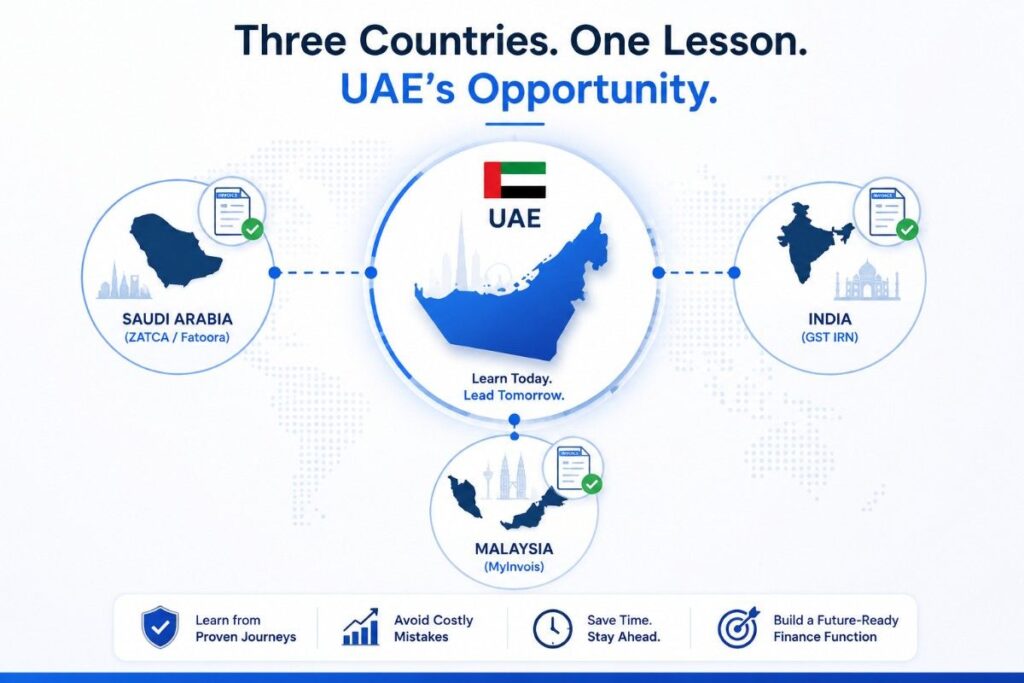
Each of those rollouts produced a public archive of mistakes:
- companies that scrambled,
- projects that overran,
- vendors that disappointed,
- regulations that surprised,
- Audit findings that became case law.
The UAE doesn’t have to repeat any of it.
Our Team members have sat in advisory engagements across three of those jurisdictions. Below are the ten lessons that apply most directly to UAE finance leaders right now. They’re organized by the function inside your business that owns each lesson:
- Finance,
- IT,
- Tax,
- Operations,
- The CFO chair itself.
Lessons from KSA (ZATCA / Fatoora)
Saudi Arabia rolled out e-invoicing in two big phases starting in December 2021.
Phase 1 was “generation” (issue invoices in a structured electronic format)
Phase 2 was “integration”, which required real-time submission to ZATCA in waves, by taxpayer size.
Lesson 1- The phasing surprises bigger taxpayers, not smaller ones.
In KSA, the assumption was that small businesses would struggle and large ones would glide. The opposite happened. The biggest taxpayers had the most complex setups, like:
- multiple ERPs,
- group structures,
- integration with procurement and logistics systems,
- custom workflows.
They underestimated effort by 40–60%. Smaller, simpler businesses just bought a turnkey ASP and moved on.
UAE implication: If you’re a large group, do not anchor on small-business experiences. Budget 2x what you think.
Lesson 2- ZATCA’s public list became a buying signal, not just a compliance list.
Within months, “Is this vendor on the ZATCA list?” became the procurement question. Companies that weren’t on the list lost deals, sometimes for reasons unrelated to e-invoicing, because procurement teams used the list as a proxy for “are these guys real?” The brand effect was significant.
UAE implication: The FTA’s public ASP list will become a brand signal far beyond compliance. If you’re an ASP, your placement on that list matters disproportionately. If you’re a buyer of an ASP, “are they on the list” should be your first filter, not a footnote.
Lesson 3- Arabic-language content in invoices was harder than expected.
ZATCA required bilingual invoices for certain customer-facing fields. Many ERPs had degraded Arabic support.
Companies that hadn’t tested Arabic output in their ERP’s invoice flow before (most hadn’t) discovered the problem at the worst possible moment.
UAE implication: Test your ERP’s Arabic invoice output now. PINT AE has explicit handling for bilingual content. Don’t wait to find out that your ERP has been silently producing broken Arabic for three years.
Lessons from India (GST IRP / IRN)
India rolled out e-invoicing in October 2020 for businesses above a threshold (initially INR 500 crore turnover), gradually lowering it. The system uses Invoice Reference Numbers (IRNs) generated by the Invoice Registration Portal (IRP). India’s rollout is the largest in scale and the messiest in execution, which makes it the richest learning ground.
Lesson 4- AP-side reconciliation breaks before AR-side compliance does.
Most companies focus on the outbound side, making sure their own invoices are compliant. India’s experience: the harder problem was inbound. Hundreds of suppliers, each with different ASPs, different IRN generation times, and different correction practices. The accounts payable team became reconciliation specialists overnight. Companies that hadn’t redesigned their AP workflow before go-live spent the first six months in spreadsheet hell.
Original invoice flows worked. Credit notes flows broke. Cancellations broke. Sequence-numbering rules surprised. Vendor-side and buyer-side corrections didn’t reconcile. The boring edge cases caused more operational disruption than the headline mandate.
UAE implication: Pressure-test credit notes, debit notes, corrections, RCM scenarios, and cancellations with your ASP before signing.
Specifically, ask for a live demo of each. If they can’t demo, they haven’t solved it.
Lesson 6- Master data quality became the single biggest predictor of success.
Companies with clean customer master data (correct TRNs, consistent legal names, accurate addresses) glided. Companies with messy master data the same customer entered four different ways across four entities suffered for 18 months. Master data hygiene is the most boring and most consequential pre-mandate investment.
UAE implication: Run a 30-day customer master data audit now across all entities. De-duplicate, normalize legal names, validate TRNs. Do this before you talk to an ASP. The ROI is measured in audit fines avoided.
Lessons from Malaysia (MyInvois)
Malaysia went live with MyInvois in phases starting in August 2024. Many UAE businesses with Malaysia operations have already lived through it, which makes their lessons immediate and operational.
Lesson 7- Free trial/sandbox time was not enough companies that used the full window won.
LHDN (the Malaysian tax authority) gave businesses a generous testing period. Companies that used it ran integration tests, fixed master data issues, trained AP teams, briefed customers, and went into go-live on a Tuesday.
Companies that treated the sandbox as optional went into go-live on a Wednesday and were in war-room mode by Friday.
UAE implication: When the FTA opens its testing sandbox, use every available day. Not “as much as we can”. Every day. This is the most predictive variable for a smooth go-live across all jurisdictions we’ve seen.
Lesson 8- Customer communication separated the professionals from the panickers.
Companies that proactively guided their customers through the changes weeks in advance enjoyed a stress-free transition. Those who didn’t pay the price with overwhelmed support inboxes for a month.
UAE implication: A customer communication plan is not optional. It’s a 4-step sequence: 60-day heads-up, 30-day specifics, 7-day reminder, day-1 confirmation. Draft it now; send it when the FTA confirms your phase.
Lessons that emerged across all three jurisdictions
Lesson 9- The “go-live” date is the start of operations, not the end of the project.
Universal mistake: project teams disband on day 1 of live operations. Then in week 6, rejection rates climb, master data gaps surface, and there’s no one with authority and context to fix them. The 90 days after go-live are when the project actually gets implemented.
UAE implication: Plan and budget for a 90-day post-go-live war room. One full-time owner. Weekly scorecard. Then, formal handover to BAU.
Lesson 10- The CFO who treats this as “the IT team’s problem” loses 18 months.
In every market, the companies that scaled the cleanest were the ones where the CFO personally chaired the steering committee for the first 90 days. Not because the CFO needed to manage the technical detail, but because the cross-functional friction (Finance vs IT, Tax vs Operations, AR vs AP) is only resolved at the CFO level. Delegating downward delayed every project by months.
UAE implication: This is not an IT project. It’s a CFO-led finance transformation that happens to use IT. Show up. Chair the meeting. Set the tone.
Don’t Let the UAE Become the Next Cautionary Tale
KSA rushed. India patched holes mid-flight. Malaysia learned the hard way that “compliant on paper” and “compliant in practice” are two very different things. The UAE still has a window to get this right, but that window is closing fast as FTA enforcement tightens and e-invoicing mandates roll out in phases.
The businesses that will sail through aren’t the ones scrambling after a penalty notice; they’re the ones auditing their exposure now. If you’re unsure where your gaps lie, start with a professional financial statement audit to see exactly where you stand, or, if you’re operating out of DIFC, a DFSA-regulated audit built for that specific regulatory lens.
From there, our tax advisory services team can map out a compliance strategy that doesn’t just react to deadlines but anticipates them, including hands-on support for e-Invoicing readiness so you’re not still figuring out integration when Phase 2 hits. And because compliance isn’t just about tax anymore, our regulatory compliance advisory services help you stay ahead of the broader framework shifts, too.
The mistakes have already been made, just not by you. Let’s keep it that way. Talk to our team before the UAE writes its own version of this story.



Stay Ahead of the Curve
Subscribe for Expert Audit and Financial Insights Directly to Your Inbox.