

e-invoicing, e-Invoicing Solution, Finance
Training Your Finance Team for E-Invoicing: What Nobody Puts in the Project Plan
16 SEPTEMBER 2026 • 5 Min read
Training is the most consistently under-budgeted, under-scheduled, under-respected workstream in the UAE for e-invoicing projects. Here’s why it shouldn’t be and what good actually looks like.
In every project failure-mode list we publish, Reasons E-Invoicing Projects Fail (and How to Spot Them Early); one entry sits in the bottom third and gets the least attention: “Training was treated as the last item on the project plan.”
It deserves to be in the top three.
We’ve watched roughly four UAE finance teams in the past year discover the same thing at go-live: the ERP is configured, the ASP is connected, the PINT AE invoices are flowing, and the AP and AR staff who actually have to work this system every day were briefed in a 90-minute session two weeks before cutover. By week three of production, they’re working around the system rather than through it. Exceptions stack up. Customers complain. The CFO wonders why the project that “went live successfully” feels worse than the old way.
It’s not the system, it’s the training. Here’s how to do it properly.
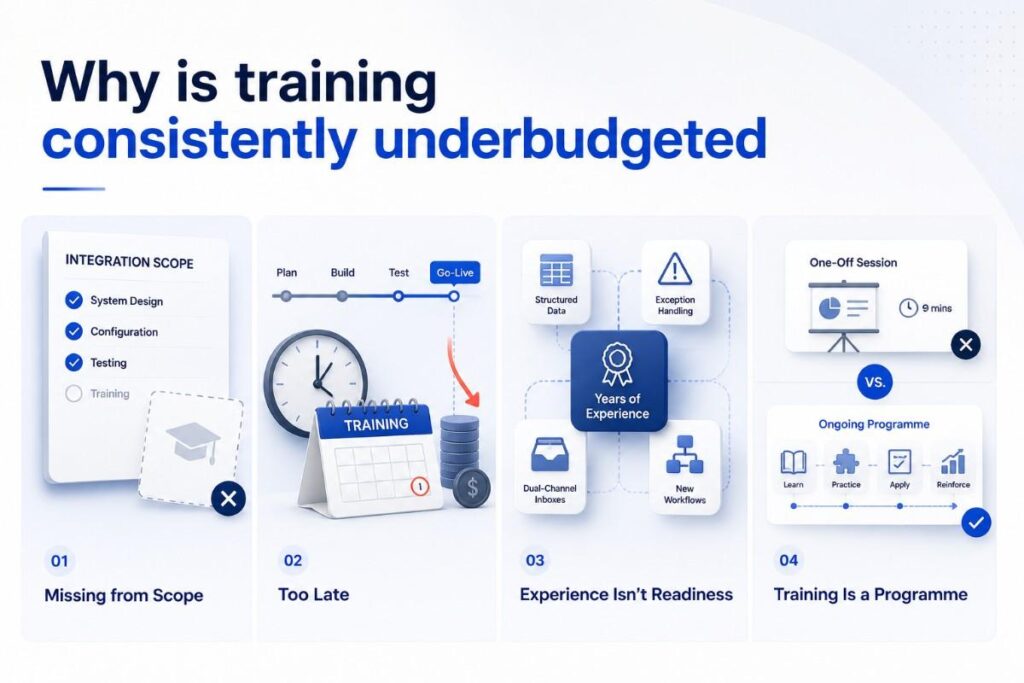
Part 1: Why training is consistently underbudgeted
- Reason 1: It feels soft. Training doesn’t appear in the technical scope. It’s not a deliverable in the integration. It’s easy to defer.
- Reason 2: It happens late in the project. By the time training is due, the project budget is tight, the team is tired, and the “we’ll do it next month” instinct wins.
- Reason 3: “Our team is experienced” is a flattering assumption. AP and AR teams that have been excellent for years can still struggle with structured-data workflows, exception handling, and dual-channel inboxes because these are different skills, not lesser skills.
- Reason 4: Training is treated as a one-off session, not a program. A 90-minute briefing on go-live week isn’t training. It’s a notification.
Part 2: What a good training program actually looks like
A proper UAE e-invoicing training program runs 6 weeks, with role-specific tracks, paired learning, and reinforcement after go-live. Here’s the structure:
Week 1: Foundation (all-hands)
- What is changing in our finance operations and why
- PINT AE, the FTA model, and the 5-corner network at a high level
- The new workflow at a glance: what each role will experience differently
- Q&A and concerns capture
Weeks 2-3: Role-specific deep dives
- AP team: dual-channel inbox, structured invoice receipt, three-way matching at scale, exception handling, supplier communication scripts
- AR team: structured invoice issuance, credit note workflow, customer query response, dispute and correction handling
- Tax and compliance: VAT impact, audit-trail navigation, regulatory updates, exception reporting
- Each role gets 2-4 hours of structured content + hands-on exercises
Week 4: Hands-on labs
- Sandbox-based scenarios using anonymized real data
- Common exception cases walked through end-to-end
- Pair-learning experienced staff are paired with newer staff
- A mistake-friendly environment encourages breaking things to learn how to fix them
Week 5: Process and judgment
- When to escalate vs when to resolve at the desk
- Customer-communication tone and scripts
- Supplier-communication tone and scripts
- “Grey area” decisions exception types where judgment, not procedure, applies
Week 6: Pre-go-live readiness
- Final dry-run with realistic volume
- Question-bank capture for the war-room phase
- Named ownership of post-go-live training reinforcement
- Confidence checks: each person describes one scenario they feel ready for and one they’re still nervous about
Part 3: Five training mistakes to avoid
1. Treating training as a one-off session. Training is a program, not an event.
2. Identical content for everyone. AP, AR, tax, IT, and operations need different tracks; generic content disrespects everyone’s time.
3. Theory without hands-on. Slides without sandboxes leave the team unable to actually do the work.
4. Skipping the senior staff. “They’ll figure it out” is the most expensive sentence in finance change management. Senior staff are role models; train them first and visibly.
5. No reinforcement post-go-live. Three weeks after cutover, half the content has faded. Plan reinforcement sessions in months 1, 2, and 3.
Part 4: Budget and resourcing
- Effort – Mid-market group (50–200 finance staff): roughly 4-6 weeks of one dedicated trainer’s time plus 1 day of attendance per team member. Use a mix of internal and external trainers.
- Cost – Internal training (your own L&D + finance leads): the staff time is the cost. External support for content design and senior-track delivery typically costs much less than the cost of a botched go-live.
- Format – “In-the-flow-of-work”, content quick reference cards, short videos, embedded prompts outperform classroom sessions for retention. Invest accordingly.
Part 5: Who owns training in your project?
In a well-structured UAE e-invoicing project, training has a named owner, usually a senior finance manager or L&D partner with budget, calendar, and authority. Not “we’ll figure out who owns this later.”
Training owners we’ve seen succeed share three traits:
- Operational credibility: they’ve actually done AP or AR work themselves
- Comfort with both structured content and unstructured Q&A
- Authority to escalate when the project leadership tries to compress the training timeline (which they will)
Your Go-Live Date Isn’t the Finish Line; Your Team’s Readiness Is
A system can be fully configured and still fail on the floor if the people running it were given a 90-minute briefing two weeks before cutover. Training is the workstream most UAE e-invoicing projects quietly shortchange, and it’s usually the reason go-lives that looked clean on paper feel chaotic in week three.
KPI’s tax advisory team in the UAE works with finance leaders to build role-specific training programmes, not one-off sessions, so AP, AR, and tax staff are ready for structured invoicing before it hits their desks. If you’re planning a PINT AE rollout and training hasn’t been scoped yet, our e-invoicing advisory specialists can help you build a six-week programme with named ownership and post-go-live reinforcement built in.
Still treating training as a checklist item instead of a programme? Talk to KPI before your project plan finalizes the training slot as an afterthought.



Stay Ahead of the Curve
Subscribe for Expert Audit and Financial Insights Directly to Your Inbox.