

e-invoicing, e-Invoicing Solution
E-Invoicing for UAE Retail: The Till-to-FTA Journey
07 SEPTEMBER 2026 • 6 Min read

From the customer’s receipt at the till to the FTA’s acknowledgement, every step of how retail e-invoicing actually works.
Retail is the industry where the gap between “what the regulation says” and “what happens on a busy Friday at the mall” is widest. For most other industries, e-invoicing is a back-office finance problem. For retail, it’s a front-office customer-experience problem first and a back-office finance problem second.
A customer at a till in Dubai Mall doesn’t want to wait while the system validates an invoice with the FTA. A small grocery store in Sharjah issuing 4,000 receipts a day cannot have each one fail validation in real-time. A petrol station forecourt cannot freeze if the network drops. And yet, every one of those transactions, under the UAE’s e-invoicing framework, must end up correctly captured, formatted, and reported.
This guide walks the retail e-invoicing journey end-to-end: where the friction points are, where the regulations bend to operational reality, and where retail finance leaders need to focus their planning efforts.
Part 1: What “Retail” actually means under UAE e-invoicing
The first clarification: UAE e-invoicing doesn’t use the word “retail” as a regulatory category. It uses the distinction between standard tax invoices (typically B2B) and simplified tax invoices (typically B2C, low-value, at point of sale).
For retail, this matters enormously. The simplified tax invoice, the receipt a customer gets at the till, has lighter content requirements than a full B2B invoice. It doesn’t need the buyer’s TRN, and doesn’t need full buyer details, doesn’t need bilingual line-item descriptions in most cases. That’s operational mercy.
But “simplified” does not mean “outside scope”. Simplified tax invoices are still in scope of the e-invoicing framework. They still must be structured, captured, and reported. The reporting model for high-volume simplified invoices may use batched submission rather than per-invoice real-time transmission, but the audit trail and the reporting obligation remain.
Practical implication: your POS system, not just your back-office accounting system, becomes part of your e-invoicing compliance footprint. Most retailers have not yet absorbed that.
Part 2: The till-to-FTA journey, step by step
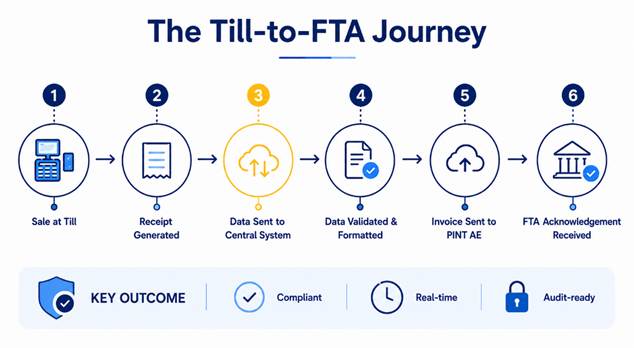
Here is the actual flow for a retail transaction in the scope of e-invoicing:
- Step 1- Customer pays at the till. POS captures the transaction.
- Step 2- POS generates the simplified tax invoice (receipt) and prints/emails it to the customer immediately. This is the customer-facing moment. It must remain instantaneous.
- Step 3 – POS forwards the transaction data to your retail management or central accounting system. Most modern POS systems do this in real-time; older ones do it in end-of-day batches.
- Step 4 – Your central system aggregates, formats, and prepares the data for e-invoicing transmission. This is where your ASP integration sits.
- Step 5 – Your ASP converts the data into PINT AE structured format, applies digital signatures, and transmits to the FTA (either per invoice or in approved batches, depending on volume and scope).
- Step 6 – FTA acknowledges receipt. Your audit trail is closed for each transaction.
The customer-facing moment (steps 1–2) cannot be slowed by e-invoicing infrastructure. The compliance moment (steps 4–6) happens behind the scenes. Step 3, the bridge between POS and the central system, is where most retailers have unresolved gaps.
Part 3: The four pain points unique to retail
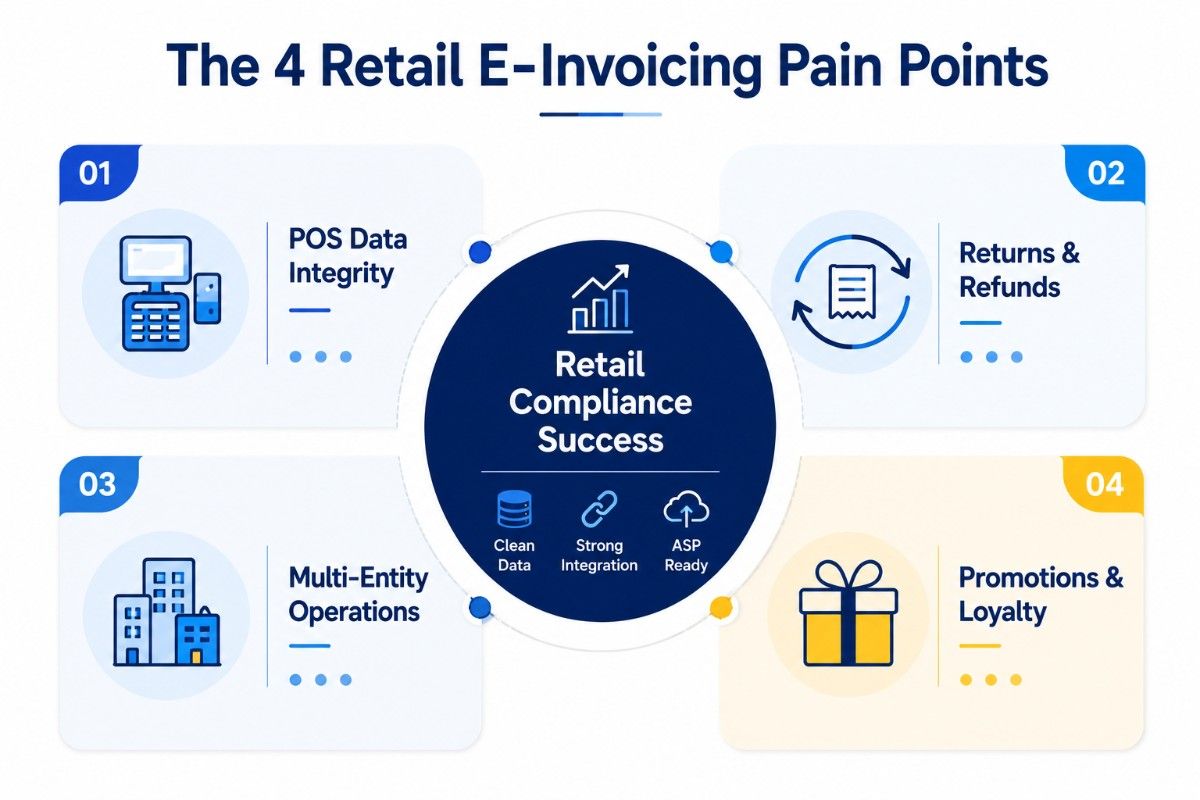
Pain point 1: POS-to-back-office data integrity
Most UAE retail chains run more than one POS system across their store estate. A mall flagship runs an enterprise POS. A neighborhood express store runs a lighter mid-market product. A pop-up runs a tablet-based solution. Each speaks a slightly different dialect. The data that arrives in your central accounting system from these systems is rarely uniform:
- different tax codes,
- different field naming,
- different timestamp formats,
- different handling of voids and refunds.
E-invoicing exposes every inconsistency. Master the POS-to-central-system data layer before you talk to an ASP.
Pain point 2: Returns, refunds, and exchanges
Retail has the highest volume of credit notes and corrections of any industry. A customer returns a shirt three days later. An exchange happens at a different store from the original purchase. A partial refund is processed against a multi-item original receipt. Each of these scenarios must produce a properly linked credit note that references the original simplified tax invoice. Most POS systems handle this internally already, but the way they hand it off to your central system, and onward to your ASP, is where compliance breaks. Pressure-test this flow before go-live, not after.
Pain point 3: Multi-entity, multi-emirate operations
A typical UAE retail group has entities across mainland Dubai, mainland Abu Dhabi, and one or more free zones (Jebel Ali Free Zone, Sharjah Airport Free Zone, etc.). Each entity has its own TRN, its own invoice numbering sequence, and its own scope of applicability under e-invoicing phasing. The POS estate often does NOT mirror this legal structure; one POS system may serve stores belonging to two different legal entities. Reconciling the POS world to the legal-entity world is a project in itself. Start it before the e-invoicing project, not during.
Pain point 4: Promotions, loyalty, and price modifications
Retail invoices are rarely “clean”; they carry promotional discounts, loyalty-point redemptions, gift card payments, mixed-tender splits. Each modifier affects the VAT calculation. PINT AE has fields to handle these, but the way your POS exposes them to your central system may not map cleanly. A 10% discount applied as a line-item modifier vs. a footer modifier produces the same receipt of total but different structured invoice data. Decide your mapping convention before integration, not in month four.
Part 4: A practical 90-day retail readiness plan
Here’s the sequence we recommend for any UAE retail group:
- Weeks 1-2: POS inventory: every system, every store, every version. List it.
- Week 3: Legal-entity-to-POS mapping. Which POS serves which entity? Resolve any “shared POS, split entity” issues.
- Weeks 4-5: Data audit: pick 1 week of POS data per system. Look at tax codes, field consistency, refund handling, and mixed tender. Flag every inconsistency.
- Week 6 – Customer master data audit (for B2B portion of retail, corporate gifting, bulk sales, account customers). TRN validation in particular.
- Weeks 7-8: ASP shortlist and demo, specifically demo retail edge cases (high-volume batching, returns, multi-tender).
- Weeks 9-10: Integration Design: POS → Central → ASP. Decide the mapping convention for discounts, loyalty, and gift cards.
- Weeks 11-12: Sandbox testing with real (anonymized) retail data, including peak-volume scenarios.
Part 5: The board-level question retail CFOs are asking
Most retail boards are asking the wrong question: “Will our POS systems be compliant?” The right question is: “Will our POS-to-back-office data pipeline be compliant?” The POS vendors will almost certainly produce compliant output. The pipeline between them and the FTA is your problem.
Your Till Is Compliant. Is the Pipeline Behind It?
Every receipt of your POS prints is only the first move in a much longer compliance chain, one that has to survive multi-store rollouts, mid-month refunds, and mismatched TRNs across entities without ever slowing down the customer at the counter.
Most retail groups don’t find the cracks in that pipeline until an ASP integration or an FTA audit forces the issue. KPI’s e-invoicing advisory team works directly with UAE retailers to map POS-to-back-office data flows, close the gaps in returns and multi-tender handling, and get your PINT AE structuring right before go-live, not after.
If your broader VAT and invoicing framework also need a second look, our tax advisory services and regulatory compliance advisory teams work alongside the e-invoicing specialists to keep every layer aligned with FTA requirements.
Talk to KPI’s advisors and get in touch here to start your 90-day retail readiness plan.



Stay Ahead of the Curve
Subscribe for Expert Audit and Financial Insights Directly to Your Inbox.