

e-invoicing, e-Invoicing Solution
UAE e-Invoice Format Explained: Fields, Framework and Implementation Timeline
15 APRIL 2026 • 14 Min read

Table Of Contents
- Key highlights
- What is e-invoicing in the UAE
- What is the UAE e-invoicing implementation timeline
- Understanding the UAE e-invoicing framework and process
- 5 Key components of the UAE e-invoicing model:
- How the UAE e-invoicing framework works:
- What is the UAE e-invoice format
- What fields must be included in a UAE e-invoice
- What are the benefits of e-invoicing for businesses
- How to prepare for UAE e-invoicing compliance
- How can KPI supports UAE e-invoicing readiness
- Final thoughts
- FAQs
Key highlights
- Understand the UAE e-invoice format and mandatory fields for compliance
- Learn the phased 2026–2027 implementation timeline for businesses
- Explore the e-invoicing framework and roles of suppliers, buyers and ASPs
- Discover the benefits of e-invoicing for efficiency, compliance and financial visibility
- Prepare systems, ERP and processes for smooth UAE e-invoicing adoption
As part of the UAE’s digital tax transformation, the Ministry of Finance (MOF) is introducing a national e-invoicing framework. This initiative will transform the way businesses create, exchange and report invoices.
As a result, e-invoicing compliance is becoming a key priority for businesses operating in the UAE. Early preparation can help avoid disruptions and ensure smooth financial operations.
This guide outlines the key concepts, requirements, implementation timeline and practical considerations of e-invoicing in the UAE, helping businesses navigate these changes with clarity and confidence.
What is e-invoicing in the UAE
e-Invoicing in the UAE refers to the digital creation, exchange and storage of invoices using standardized electronic formats. Instead of paper invoices or emailed PDFs, businesses generate invoices as structured data that systems can process automatically. This approach supports faster transactions, improves data accuracy and enhances transparency in financial reporting.
For an invoice to qualify as a valid e-invoice under UAE requirements, businesses must follow several key principles:
- Create invoices in structured digital formats: Invoices must be generated as machine-readable data files, typically XML-based formats aligned with PINT AE (Peppol International Invoice – UAE), rather than PDFs, images or paper documents.
- Follow standardized data specifications: Invoice data must comply with the PINT AE standard, which defines the structure, mandatory fields and validation rules.
- Transmit invoices through Accredited Service Providers (ASPs): Businesses must exchange invoices through MoF-accredited service providers connected to the Peppol network, ensuring secure validation and standardized transmission.
These requirements ensure that invoices are processed efficiently and securely within the digital ecosystem. Understanding this foundation helps businesses prepare for the upcoming phases of adoption and compliance.
What is the UAE e-invoicing implementation timeline
The UAE will introduce e-invoicing through a phased schedule between 2026 and 2027. This approach gives organizations time to upgrade systems, align processes and prepare gradually.
The UAE e-invoicing rollout timeline is structured as follows:
- Pilot programme: Selected organizations begin participating in controlled testing of the national e-invoicing environment from 1 July 2026. This pilot phase helps assess system connectivity, validate workflows and evaluate operational readiness.
- Voluntary adoption: From 1 July 2026, businesses may adopt e-invoicing before it becomes mandatory. Early participation allows organizations to test their systems and refine compliance processes.
- Phase 1: Companies generating AED 50 million or more in annual revenue must appoint an Accredited Service Provider (ASP) by 31 July 2026. Mandatory compliance for these entities begins on 1 January 2027.
- Phase 2: Companies with annual revenue below AED 50 million must appoint an Accredited Service Provider by 31 March 2027. Mandatory compliance for these entities begins on 1 July 2027.
- Phase 3: UAE government organizations must appoint an Accredited Service Provider by 31 March 2027. Mandatory implementation for these entities begins on 1 October 2027.
This phased schedule balances regulatory enforcement with practical adoption. It allows businesses time to upgrade systems, test integrations and plan compliance.
To understand how these timelines translate into real invoice exchanges, it is important to examine the structure and participants within the UAE e-invoicing ecosystem.
Note:
- July 2026 does not mark mandatory e-invoicing. It is the first deadline to appoint an ASP. Mandatory compliance begins in phased stages during 2027, depending on the entity type.
- The above timelines are indicative based on current regulatory guidance. Final dates and requirements may be revised by the UAE authorities as the e-invoicing framework evolves.
Understanding the UAE e-invoicing framework and process
The UAE e-invoicing framework defines how electronic invoices are exchanged between businesses and reported to the tax authority. The system follows a Decentralized Continuous Transaction Controls and Exchange (DCTCE) model based on the Pan-European Public Procurement On-Line (Peppol) five-corner architecture.
This structure ensures invoices move through secure, standardized channels while maintaining regulatory visibility over tax data.
5 Key components of the UAE e-invoicing model:
- Issuer (Supplier): The business that generates the e-invoice after completing a transaction and sends it through its connected ASP.
- Receiver (Buyer): The business that receives the e-invoice through its service provider and records it in its accounting or ERP system.
- Federal Tax Authority (FTA) e-billing system: The government platform integrated with the Peppol PINT (Peppol Invoice Standard) for data exchange. It functions as an invoice repository that receives tax-related data from both the sender’s and receiver’s ASPs. While the platform maintains records for compliance and reporting, it does not perform invoice validation.
- Issuer ASP: The approved provider that validates the supplier’s invoice structure and securely transmits the e-invoice to the buyer’s service provider through the network.
- Receiver ASP: The provider that checks the received invoice, confirms its technical status and delivers the invoice to the buyer’s system.
How the UAE e-invoicing framework works:
Step 1: The supplier creates the e-invoice in their accounting or ERP system and submits it to their connected ASP in an agreed-upon digital format, such as JSON or XML.
Step 2: The sender’s ASP validates the invoice for technical accuracy and required data fields, then it converts the invoice into the UAE-approved PINT AE XML format to ensure compliance with the standardized schema.
Step 3: After validation, the sender’s ASP transmits the PINT AE-formatted invoice through the Peppol e-invoicing network to the buyer’s ASP. At the same time, it sends a Tax Data Document (TDD), a tax-relevant extract of the invoice, to the government platform.
Step 4: The buyer’s ASP checks the received invoice for technical issues and network compliance. It then sends a Message Level Status (MLS) response back to the sender’s ASP indicating, whether the document passed the checks.
Step 5: Once technical validation is completed, the buyer’s ASP forwards the invoice to the buyer’s ERP or accounting system in the format agreed between the parties.
Step 6: After successful validation, the buyer’s ASP submits the TDD to the government platform for compliance reporting. If the invoice fails validation, the ASP sends an MLS notification instead and does not transmit the TDD.
Step 7: The government platform records the submitted tax data and returns status messages to both the sender’s and buyer’s ASPs, confirming successful submission or highlighting any issues.
Step 8: The sender’s ASP relays the status messages it receives from the buyer’s ASP and the government platform to the supplier, confirming whether the invoice exchange was successful.
Step 9: The buyer’s ASP also forwards the reporting status received from the government platform to the buyer, completing the compliance reporting process.
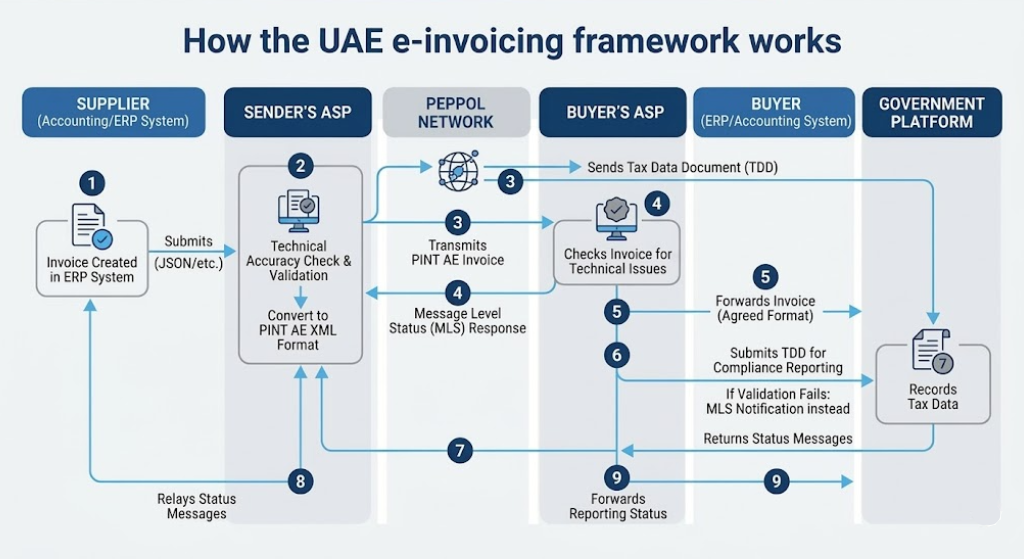
Through this interconnected framework, the UAE ensures that invoices are exchanged securely, verified by ASPs and reported efficiently for regulatory oversight.
While the framework explains how invoices move across the network, businesses must also understand the format every electronic invoice must follow.
Also read: UAE E-Invoicing Guide: Prepare for 2026–2027 Phased Rollout
What is the UAE e-invoice format
The UAE e-invoice format is a standardized XML structure based on the PINT AE Data Dictionary. It organizes invoice data into defined sections, enabling machine-readable processing, accurate VAT reporting and consistent exchange between businesses, while relevant tax data is shared with the FTA.
The key sections of a UAE e-invoice include:
1. Invoice header: Provides general identification details of the invoice:
- IBT-001 (Invoice Number): Unique sequential identifier for the invoice.
- IBT-002 (Invoice Issue Date): Recorded in YYYY-MM-DD format.
- IBT-003 (Invoice Type Code): Specifies the document type (tax invoice, credit note or debit note).
- IBT-005 (Currency Code): Follows ISO 4217 standards (e.g., AED, USD).
2. Seller and buyer details: Provides identification information for both parties involved in the transaction:
- IBT-027 / IBT-044 (Seller/Buyer Name): Legal names of the supplier and the buyer.
- IBT-031 / IBT-048 (TRNs): Tax Registration Numbers used for VAT compliance
- IBT-034 / IBT-049 (Electronic Addresses): Digital endpoints used for invoice exchange through the network.
- IBG-05 / IBG-08 (Postal Address Groups): Physical address details such as street, city and country.
3. Line items: List each product or service supplied:
- IBT-153 / IBT-154: Item name and description
- IBT-129 / IBT-146: Quantity and net unit price
- IBT-151 / IBT-152: Tax category and applicable VAT rate
- IBT-158 (HSN Code)/BTUAE-17 (SAC Code): Commodity classification codes for goods or services.
4. Tax Breakdown: Shows how VAT is calculated:
- IBT-116 (Taxable Amount): Value before VAT
- IBT-117 (Tax Amount): VAT charged
- IBT-118 (Tax Category Code): Standard, zero-rated, exempt or reverse charge
- IBT-119 (Tax Rate): VAT percentage applied to the item or service
5. Totals and Payment Details: Summarizes calculations and payment instructions:
- IBT-109: Total amount without VAT
- IBT-110: Total VAT amount
- IBT-112: Grand total with VAT
- IBT-115: Final payable amount
- IBT-081 (Payment Means Code): Method of payment, e.g., bank transfer or card
The UAE e-invoice format ensures invoices are standardized, machine-readable and VAT compliant, reducing errors and streamlining exchange and audits.
Now that the format is clear, businesses must focus on the key fields each e-invoice should contain to remain compliant.
What fields must be included in a UAE e-invoice
For an e-invoice to be valid under UAE regulations, it must contain specific structured data fields defined by the MOF. These fields follow the UAE e-invoicing data dictionary and align with international Peppol standards.
Including the correct information ensures invoices can be processed automatically and exchanged smoothly between business systems.
Key mandatory data fields include:
- Supplier information: Legal business name, Tax Registration Number (TRN), registered address, contact details and the ASP identifier or system ID used for invoice transmission.
- Recipient information: Buyer’s legal name, TRN if the business is VAT-registered, registered address and contact information required for transaction identification.
- Invoice metadata: Unique invoice number or UUID, invoice issue date and time, invoice type code and the currency code used in the transaction.
- Transaction details: Description of goods or services, quantity, unit price, line totals before tax, applicable VAT rate and amount per line and any discounts or adjustments.
- Tax summary details: Total taxable amount, total VAT amount and the final invoice value inclusive of VAT.
- Digital transmission details: Transmission timestamp and system acknowledgment ID.
Including these mandatory fields ensures invoices meet compliance requirements and can be processed accurately by both buyer and FTA systems.
Meeting these field requirements ensures invoices are technically compliant. But beyond compliance, e-invoicing also introduces several operational advantages for businesses.
What are the benefits of e-invoicing for businesses
e-Invoicing is not just a compliance requirement. It is a structural shift designed to address long-standing inefficiencies in invoice processing and tax reporting. Traditional invoicing methods often rely on manual inputs, delayed validations and fragmented systems. These gaps can lead to errors, fraud risks and limited visibility into tax obligations.
By standardizing how invoices are created, exchanged and reported, e-invoicing helps businesses operate with greater accuracy and control.
Key benefits include:
- Reduced risk of invoice fraud: Standardized formats and system validations help reduce the risk of duplicate, altered or fake invoices entering the system. This lowers exposure to fraudulent transactions.
- Improved VAT compliance and reduced tax gaps: Real-time or near real-time reporting supports accurate transaction recording. This helps minimize discrepancies between reported and actual tax liabilities.
- Automated audit processes: Digital records and structured data make it easier for authorities to verify transactions. This reduces reliance on manual audits and simplifies compliance checks.
- Enhanced real-time tax visibility: Businesses gain better visibility into their tax positions as transactions are processed. This supports faster decision-making and improves financial planning.
e-Invoicing creates a more transparent and efficient financial environment for both businesses and regulators. It reduces operational risks while improving the reliability of tax reporting.
Understanding these benefits highlights why early preparation matters, especially as organizations align their systems and processes with upcoming UAE e-invoicing requirements.
How to prepare for UAE e-invoicing compliance
Preparing early helps businesses transition smoothly to the UAE e-invoicing framework. Organizations should align their invoicing systems, processes and compliance practices to ensure invoices follow the required structured format.
Some important preparation steps include:
- Evaluate implementation timeline and scope: Determine when your business must comply based on factors such as size, revenue and transaction type. Identify which transactions require e-invoicing and which are exempt.
- Appoint an ASP: Select an FTA-approved ASP early in the process. The provider will convert invoices into XML or JSON formats, perform digital validation and securely transmit them to the FTA and buyers.
- Leverage pilot testing: Use the pilot phase to test ERP and ASP integration within the FTA sandbox. Verify data accuracy, process sample transactions and train staff on updated workflows.
- Establish data governance and storage: Store all e-invoices and credit notes within the UAE. Implement secure archiving, controlled access and reliable retrieval processes to support audits and reporting.
- Ensure reporting and compliance readiness: Update VAT workflows to support real-time reporting. Establish protocols for system failures and train teams to manage compliance requirements effectively.’
- Upgrade ERP systems: Ensure your ERP platform (e.g., systems like Oracle NetSuite) can generate structured invoice data (XML or JSON) and map all mandatory fields to the Ministry’s PINT AE data dictionary. Enable seamless ERP system and ASP integration, so invoices can be validated, converted into the required format and transmitted through the e-invoicing network for compliance reporting.
Early preparation reduces compliance risks and helps businesses adopt the UAE e-invoicing model without disrupting existing financial and billing operations.
However, preparation goes beyond system readiness. Expert guidance helps businesses navigate PINT AE standards, ASP integration and FTA reporting requirements effectively.
How can KPI supports UAE e-invoicing readiness
Implementing e-invoicing is not a standalone system change. It requires alignment across tax rules, ERP systems and invoice workflows. Businesses must ensure that data structures, reporting formats and processes meet regulatory expectations.
Without a structured approach, gaps in compliance and data accuracy can emerge. A well-planned transition helps organizations maintain control while adapting to new requirements.
KPI supports this journey through focused advisory and implementation expertise. The approach combines regulatory understanding with practical system integration, enabling businesses to move forward with confidence:
- Regulatory and tax impact assessment: KPI reviews how UAE e-invoicing regulations apply to your business. VAT treatment, invoice types and transaction flows are analysed. This helps identify gaps in relation to PINT AE data and reporting requirements.
- e-Invoicing readiness assessment: Existing ERP, accounting and billing systems are evaluated to determine technical readiness. Invoice data fields and master data quality are reviewed. A structured readiness roadmap is then defined.
- ASP and solution advisory: KPI supports the evaluation and selection of an FTA-approved ASP. Integration approaches are reviewed to ensure compatibility with Peppol standards and to support seamless business operations.
- Implementation and integration support: KPI assists with ERP-to-ASP integration and invoice data mapping. Invoice generation workflows and validation checks are tested to confirm technical and operational readiness.
- Governance and ongoing compliance support: Controls are established for invoice validation, archiving and reporting. KPI also supports VAT reconciliation and regulatory updates as UAE e-invoicing requirements evolve.
With the right advisory support, businesses can adopt UAE e-invoicing with greater clarity. This strengthens compliance while maintaining reliable and efficient invoicing operations.
Final thoughts
UAE e-invoicing marks a structural shift in how invoices are created, exchanged and reported. Businesses should view this change as an opportunity to strengthen financial accuracy, transparency and control.
Early preparation will help organizations align invoice data, VAT processes and system integrations with upcoming regulatory requirements. Companies that plan ahead can adopt structured invoicing smoothly and reduce operational disruption.
A clear implementation strategy also helps maintain compliance as the UAE’s digital tax ecosystem continues to evolve.
Interested in learning how your organization can prepare for UAE e-invoicing? Feel free to contact us to discuss how KPI can help streamline your transition and strengthen compliance readiness.
FAQs
1. What does e-invoicing mean in the UAE?
In the UAE, e-invoicing refers to the digital generation,exchange and reporting of invoices using standardized electronic formats.Invoices are created as structured data files instead of PDFs or scanned documents. These files follow the PINT AE standard, which defines required fields and validation rules.Invoices are exchanged through ASPs connected to the Peppol e-invoicing network.
2. Which businesses must comply withthe UAE e-invoicing mandate?
The system applies broadly to businesses conducting B2B and B2G transactions in the UAE, subject to specified exclusions. B2C transactions and businesses exclusively engaged in B2C are excluded until a future decision. Mandatory adoption is phased from 2027 based on business category and annual revenue.
3. How can businesses generate an e-invoice?
Businesses can generate e-invoices using ERP systems, accountingplatforms or specialized invoicing software. The system must support structured invoice formats aligned with the PINT AE standard and connect to an ASP.
During invoice creation, systems capture required fields such as supplier details, invoice number, tax information and transaction data. The ASP validates the invoice and transmits it through the Peppol network to the buyer’s system. KPI provides expert guidance to help businesses implement these systems, map mandatory fields and ensure smooth e-invoicing compliance.
4. What formats are allowed for e-invoices in the UAE?
UAE e-invoices must follow a structured XML format based on the PINT AE data standard. Structured formats allow automated validation and system-to-system communication.
Formats such as PDF, scanned images or paper invoices do not qualify as valid e-invoices under the UAE framework.
5. What invoice fields arevalidatedby the UAE Ministry of Finance and Federal Tax Authority?
The UAE e-invoicing framework validates several mandatory invoice fields. These ensure accurate tax reporting and compliance.
Key validated fields include:
- Supplier name, address and Tax Registration Number (TRN)
- Buyer details and TRN, where applicable
- Unique invoice number and issue date
- Description of goods or services
- Quantity, unit price and line totals
- VAT rate, taxable amount and VAT amount
- Total invoice value including VAT
These fields follow the UAE e-invoicing data dictionary aligned with Peppol standards.
6. What role do AccreditedService Providers (ASPs) play in the UAE e-invoicing framework?
ASPs act as intermediaries in the UAE e-invoicing ecosystem.
Their responsibilities include:
- Validating invoice structure and format
- Converting invoices into the PINT AE standard
- Transmitting invoices through the Peppol network
- Reporting tax data to the government platform
- Sending status confirmations to both parties
ASPs ensure invoices meet technical requirements and network standards before exchange.
7. How does the UAE e-invoicing system ensure data security and integrity?
The UAE framework ensures security through structured validation, encryptedtransmission and controlled network access. Invoices are exchanged through the Peppol network, which uses standardized communication protocols.
ASPs also apply validation checks, digital identifiers and transmission timestamps. These measures help maintain data integrity, authenticity and traceability across the invoicing process.
8. Can an e-invoice include both taxable and exempt supplies?
Yes. A single UAE e-invoice can include multiple tax treatments. For example, an invoice maycontain:
- Standard-rated items
- Zero-rated supplies
- Exempt transactions
Each line item must clearly indicate the tax category, VAT rate and taxable amount. KPI can help ensure accurate mapping and reporting of all tax categories for compliance.
9. How should errors in e-invoices be corrected?
Errors in an e-invoice should be corrected using credit notes or debit notes. Businesses should notmodify the original invoice once it has been transmitted through the e-invoicing network.
Instead, the correction document must reference the original invoice and include updated values. This approach maintains a clear audit trail for tax and compliance purposes.



Stay Ahead of the Curve
Subscribe for Expert Audit and Financial Insights Directly to Your Inbox.